

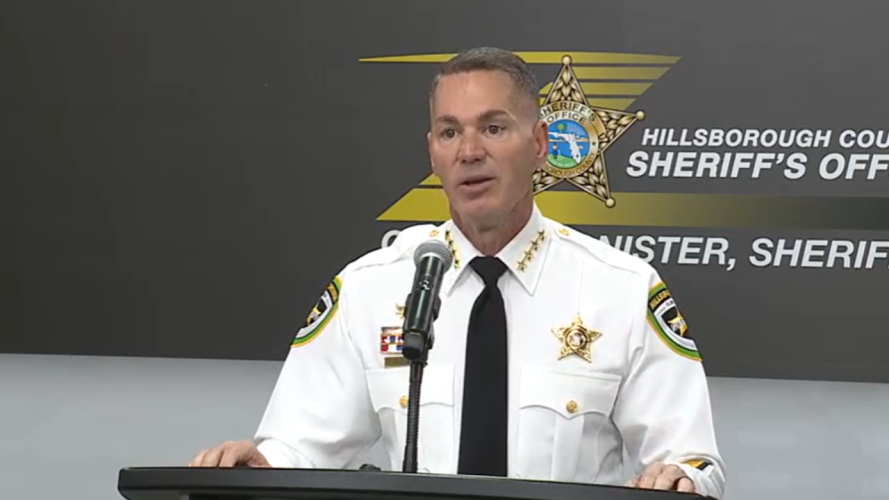


TAMPA, Fla. — Hillsborough County Sheriff Chad Chronister said six members of the Sheriff's Office were involved in an academic integrity scandal, which left them without their jobs.
Sheriff Chronister said the investigation began when they learned that a member of their office received outside help completing academic coursework that they were required to do themselves.
WATCH: 'They are not bad people': Hillsborough Sheriff employees accused of cheating in academic integrity scandal
The situation began to unfold starting with an email on July 19.
“Former Chief Deputy Anthony Collins’ wife sent an email to several individuals, one of them being me, with snapshots from text messages and emails of his communication back with what we later learned was Robert Roush, a person who authored and completed his coursework for him," said Chronister.
Chief Deputy Collins was placed on administrative leave on July 20 and resigned on July 23.
Sheriff Chronister said he launched an agency-wide investigation, which revealed more people were involved.
“We even flew investigators up to New Hampshire to meet with the paper writer and interview him, where he admitted writing papers for every one of the employees involved," said Chronister.
On October 1, Captain Lora Rivera resigned.
HCSO said on Oct. 2, Colonel Michael Hannaford and Colonel Christopher Rule were notified of the internal investigation, and on Oct. 17, both Hannaford and Rule resigned.
Authorities said Captain Zuleydis Stearns and Captain Marvin Johnson were also notified of the ongoing internal investigation, but did not resign. On Oct. 22, Captain Stearns was terminated from HCSO. Captain Johnson was terminated the day after.
On Monday, the Sheriff's Office shared over 6,000 pages of information related to their investigations. In total, HCSO listed those six employees as part of the academic dishonesty investigation.
"They are not bad people," said Sheriff Chronister. "What occurred here was not about a lack of ability or care. It was a shortcut. A moment of poor judgment. A choice that, while wrong, was not malicious."
Chronister said there’s been no evidence presented of anyone else being involved, saying that they have almost 4,000 employees and that the actions of a few won’t define the professionalism of the agency.
Questions also came up about whether this would compromise cases that these individuals might have worked on. Chronister referenced what’s known as the Brady list.
“Brady evidence is anything in a case that could tend to exculpate the defendant," said Tampa attorney Janae Thomas. "Brady evidence would include statements that the defendant made that help him or her, or in this case, you have a detective or an officer who worked the case who may have instances of dishonesty or distrust, which could cause a jury to believe them less.”
The Hillsborough State Attorney’s Office provided Tampa Bay 28 with their Brady list, where we found four people on it in connection to this investigation so far: Collins, Hannaford, Rivera, and Rule.
Thomas said the impact on cases is going to depend on their involvement.
“When people say a Brady list, it’s referring to the Brady obligation, so because the state has that obligation, they keep a list usually of everybody who could fall as Brady evidence, so any officer or deputy who has been accused of wrongdoing go on this list, so that way you know if you have a case with one of them, you need to disclose that to the defendant," said Thomas.
The Hillsborough State Attorney's Office sent the following statement explaining further:
"The disclosure of information and evidence among prosecutors and defendants is a hallmark of our criminal justice system. This includes items most people are familiar with such as DNA test results, photographs, and video recordings, as well as items people may be less familiar that may reflect on the character or credibility of witnesses at trial.
The law enforcement disclosure list is no different. It is a tool our prosecutors use to disclose information that may challenge the credibility of a law enforcement witness. The information disclosed may include criminal charges, criminal convictions, sustained internal affairs findings, or even non-final investigations into allegations that reflect on the credibility of an officer or deputy. Our law enforcement disclosure list is not a list of officers who can never testify at trial. Being placed on our disclosure list is not a comment on the content of the character of the law enforcement officer. It is merely a notice to a defendant that says we have information we must share with you and here it is. The information we disclose about law enforcement officers still requires a trial judge to determine if the evidence is even admissible in front of a jury.
Florida’s Legislature updated the legal requirements for this disclosure of information to ensure law enforcement agencies forward all sustained and finalized internal affairs findings to the prosecuting agency. The Legislature also enacted the right of a law enforcement officer to request reconsideration of being placed on this list, along with his or her right to submit documents and evidence supporting the request for reconsideration. In addition, the Legislature determined a law enforcement officer may not be disciplined or threatened with discipline solely because of his or her inclusion on our law enforcement disclosure list."

Florida law now requires restaurants to disclose fees upfront
Starting July 1, Florida restaurants must disclose all fees — including service charges and credit card surcharges — before customers order.
