

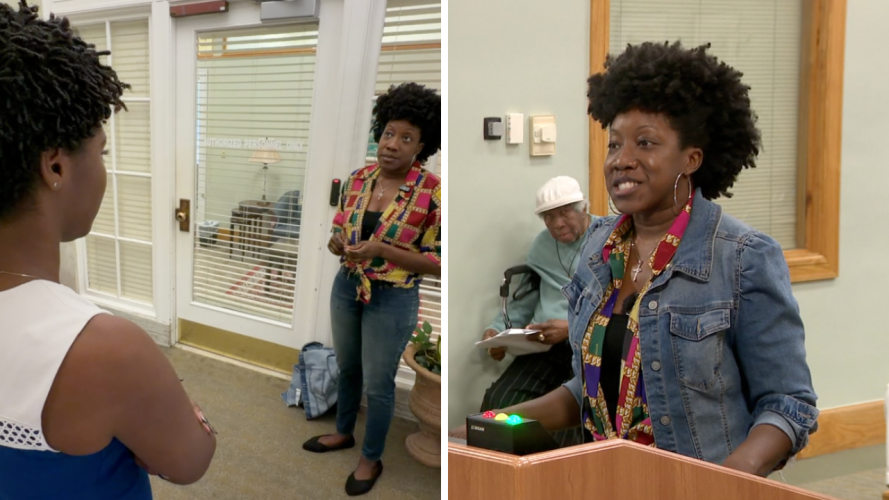


TAMPA, Fla. — Nearly every Thursday, Tampa City Council members gather at City Hall to work through a packed agenda. Toward the beginning of each meeting, the public gets three minutes to speak directly to their representatives.
While most public comment focuses on agenda items or issues throughout the city, one person comes to every single meeting. This person doesn't have an ask. Instead, she has an offer.
WATCH: Three minutes at a time, one Tampa woman is making sure Tampa's black history isn't forgotten
"My name is Ashley Morrow, and I'll be sharing Tampa's Black history," Morrow announces at the start of each appearance.
Tampa Bay 28 reporter Jada Williams noticed Morrow's weekly appearances while covering City Council meetings and set out to learn more about the woman behind the presentations.
Morrow began deep-diving into Tampa's Black history around 2020.
"I started doing deep dive research in around 2020, after the protest. I was photographing a lot of the protests and was curious about the history of this area. I learned about my personal family, and then it kind of branched out and went from there," Morrow said.
It wasn't until the death of Tampa City Councilwoman Gwen Henderson that Morrow decided to bring her research to City Hall.
"I was just interested in coming in this space. And something just said, go up there and start sharing some Black history. And that's what happened," Morrow said.
Her presentations are intentionally sequential. She started at the beginning of Tampa's Black history and has been working her way forward, three minutes at a time.
"I started from the beginning intentionally. And people do ask me to come talk about this and come talk about that, and some very popular topics. And I'm like, I'm starting at the beginning, because with history, context is very important. So like, now I'm talking about William and Nancy Ashley, but there are some context points that the council wouldn't know had I not started at the beginning," Morrow said.
During the Feb. 19 meeting, Morrow shared the story of Nancy, a formerly enslaved Black woman in Tampa whose words were recorded after emancipation.
"I believe Nancy deserves recognition, not tied to her enslaver, William Ashley, but as one of the earliest Black women in Tampa, whose words were recorded," Morrow said.
Morrow detailed how Nancy appeared in the 1870 census as William Ashley's cook following emancipation, and how she later wrote her own will in 1872, leaving her belongings to Solomon Stanton, a trustee of Beulah Baptist Institutional Church, and to her nieces.
"After emancipation, in 1870, census records show Nancy stays with William and is listed as his cook. Some people interpret that as devotion, but there are many reasons a formerly enslaved Black woman would stay. For one, she was already economically positioned through his will. Her alternative was living in poverty. So nobody wants that. Staying was not romance. It was survival," Morrow said.
Morrow also connected Tampa's racial history to broader patterns of racial violence in the 1920s, referencing events documented by the Equal Justice Initiative, including the Ocoee massacre, the Rosewood massacre and white mob lynchings. She noted that Tampa newspapers in 1929 began distancing the city from surrounding violence, and that the same year marked the first published mention of William and Nancy Ashley framed as a love story.
"Tampa is an amazing space, but we know we make up stories like pirates for Gasparilla," Morrow said.
That comment prompted a lighthearted exchange with a council member.
"Wait. They're made up? We don't have real pirates?" Councilman Alan Clendenin asked.
"We do not have real pirates," Morrow replied.
Morrow said she hopes her presentations spark broader interest in Tampa's underrepresented history, including among students and researchers.
"Hopefully we change a lot of minds. I had to change my way of thinking as well when I started learning a lot of this underrepresented history and started connecting a lot of dots," Morrow said.
Beyond City Hall, Morrow documents conversations with Black elders in Tampa on a website she created, where she records their experiences growing up in the city. She also posts her City Council presentations on social media through Black Tampa Historians.
With so much history still to cover, Morrow acknowledged her weekly three-minute segments have a long road ahead.
"It's a whole lot to go," she said.
Share Your Story with Jada
Jada Williams is focused on the issues that matter most to people in who live in Tampa and West Hillsborough County. From downtown Tampa to Town ‘n’ Country and Westchase, Jada works to bring you updates and solutions on everything from crime to infrastructure. Reach out to Jada below with your concerns for your neighborhood.
.

Bradenton community responds after 20-year-old volleyball star dies from disease that affects 2 in a million
The 20-year-old IMG Academy volleyball star and Under Armour All-American died Sept. 16 after a three-month battle with the rare blood disorder — even though doctors had found her a 100% bone marrow match, her mother, Tanya Mack tells Tampa Bay 28 reporter Haley Zarcone.
