

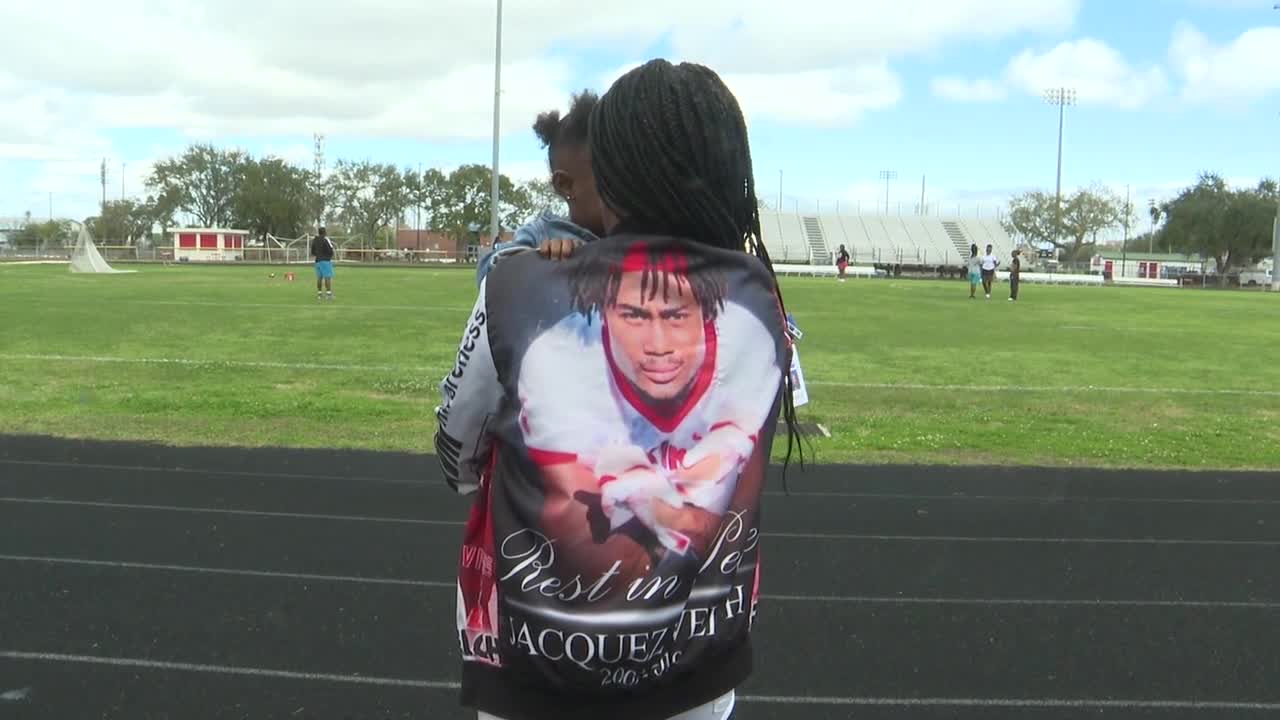


ST. PETE, Fla. — A St. Pete mother is using Black History Month as an opportunity to share her story about the son she lost, the families she’s gained, and the importance of organ donation.
“Very friendly, he had a lot of friends, big football player, he always wanted to be an NFL football player,” said Marcia Welch about her son, Jacquez.
WATCH full report by Robert Boyd
Marcia still remembers where she was sitting that Friday night in September 2019, when her son collapsed while playing football for his beloved Northeast High School Vikings.
“I thought he was having a seizure because he wasn’t responding, his eyes were rolling back, and he was clutching his teeth, so I was like, ‘he didn’t have any medical history or anything, yea, we probably need to get him up and go to the hospital,’” said Welch.
Marcia soon discovered Jacquez was born with a rare medical condition called Arteriovenous Malformation. The promising young football star had no idea his life was in danger.
“Veins in his brain that are tangled up and they are not supposed to be tangled and what happens is eventually they burst and he had a stroke on the field,” said Welch.
Jacquez died in the hospital. It was a time of tragedy, but also a time of hope, because when Jacquez got his driver’s license, he chose to be an organ donor.
“He was just that kind of person, he would do anything for anybody, and he just felt like if I can’t use it, then somebody else can,” said Welch.
Jacquez’s organs went on to save four lives, ironically, the same number he wore on his uniform, while his tissue went on to help more than 70 others in need.
“It’s like he’s still here; he might not be here physically, but mentally he is still here,” said Welch.
Marcia has now teamed up with The LifeLink Foundation to raise awareness of the power of organ donation, particularly among minorities.
“Nationwide, there are more than 100,000 people waiting for an organ transplant, 60 percent of those people are black and brown, yet black and brown people are the least likely to sign up to donate and that’s a problem,” said Sherri Day, with the LifeLink Foundation.
Day says having a voice in the community, like Marica, is a huge help to promoting their message.
“And for her to look past her grief, to hold onto the hope, and to try to make sure that other people have that information, it is really amazing,” said Day.
“Being in the black community, I think we are uneducated and quick to say, ‘no’ because we don’t know, so I feel like they should get educated,” said Welch.
For more information on the LifeLink Foundation and becoming an organ donor, go here

'My heart breaks': Woman describes helping injured students after deadly school bus crash in Polk County
A woman on her way to work Monday morning found herself helping injured Winter Haven High School students after a school bus crash that killed two people.
