

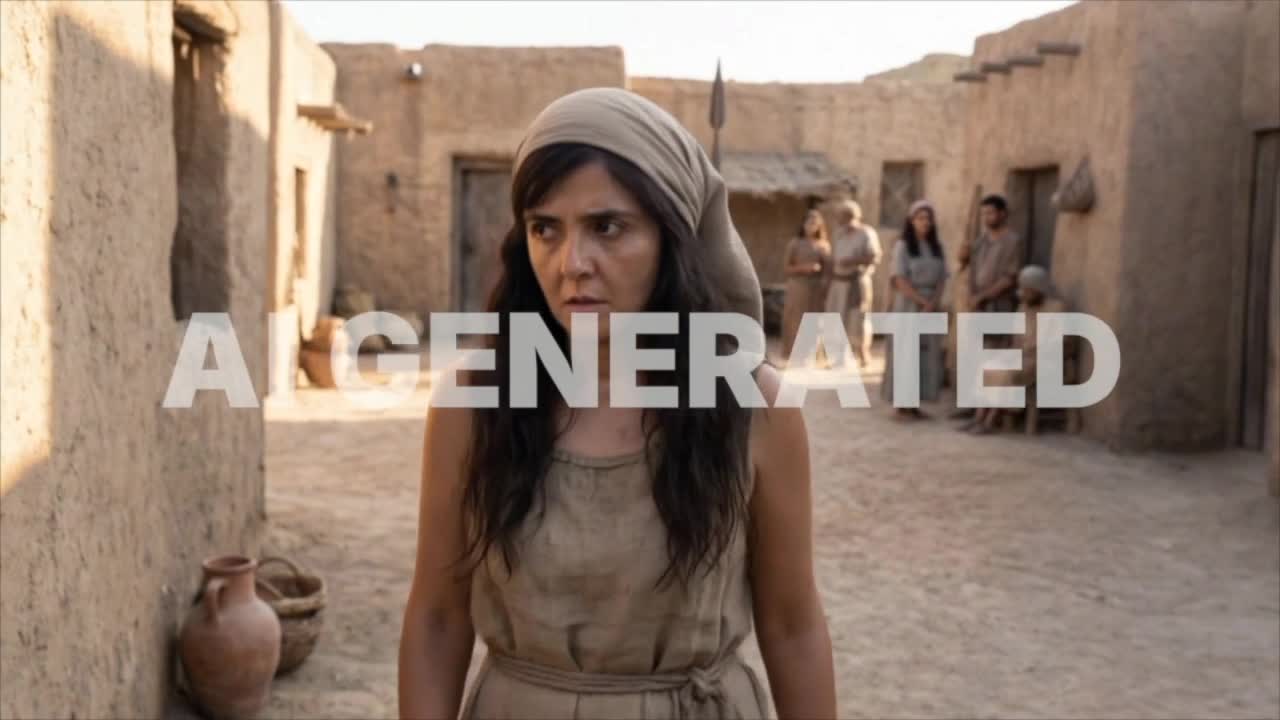


VENICE, Fla. — Venice AI filmmaker Doug Dibert created his latest movie using artificial intelligence, assembling roughly 1,800 pieces of AI-generated content into an 11-minute film now competing in a global festival with a $500,000 top prize.
Dibert, the founder of Magnfi, began working on “Defiance” in March. The movie tells the story of Jochebed, Moses' mother.
“The entire film has to be done by AI, including music,” Dibert said.
WATCH: No actors, no set: Venice filmmaker creates entire movie using AI
Dibert used multiple AI platforms to generate the movie’s video, sound, music, and images. He also used prompts from ChatGPT before bringing the individual elements into Final Cut Pro, where he edited the pieces into a finished movie.
The computer generated much of the content, but Dibert directed the process.
“And action-it's kind of the same thing, except you're calling action to a computer, and you're telling the computer, who's also the actor, the cinematographer, the, you know, lighting person, sound potentially….So you're directing all that. So it's like you're orchestrating everything with the prompting,” Dibert said.
Creating an AI movie, he said, requires more than entering a single instruction and waiting for the computer to deliver a finished product.
“The film that I made for the film festival has over, I think I want to say, around 1800 individual pieces of content. So, and then obviously, as you see in the editing timeline, I mean, it's all pieced and spliced together,” Dibert said.
AI REQUIRES A HUMAN STORYTELLER
Although AI can create the images, sounds, and characters, Dibert said the filmmaker still needs to build a story that holds the audience’s attention.
“You have to be good at storytelling. Just because the computer can give you all these great images, you still have to be a good storyteller; you still have to create something that people actually want to watch,” Dibert said.
The quality of the results also depends on the instructions the filmmaker provides.
“It’s only as smart as what you put in,” Dibert said.
The technology does not always follow those instructions.
While creating a scene showing the infant Moses floating down the Nile River in a basket, Dibert said he asked the AI program to generate a peaceful shot of the basket moving gently through the water.
“It'll just do random stuff sometimes. Okay, like one time when I was creating the scene where, you know, the Moses in the basket going down the Nile River, I wanted a shot of the basket floating right, like just gently floating down,” Dibert said. “It's floating down. All of a sudden, the basket goes and just sinks into the water. I'm like, and movie over," Dibert said with a laugh.
AI MICHAEL PALUSKA
Dibert also demonstrated the technology by creating an AI-generated version of Tampa Bay 28 reporter Michael Paluska.
He used a single selfie of Paluska as a reference image. The resulting video placed the reporter along the Nile River to promote “Defiance.”
“We gotta make it look happy though,” Dibert said.
“I don't know why I wasn’t smiling,” Paluska responded.
“This is angry Mike,” Dibert said.
“I was worried it was gonna take my job; I’m not putting that in there,” Paluska said.
Dibert then played the finished AI-generated video.
“You ready?” Dibert asked.
“I don't know if I'm ready for this,” Paluska said.
“Here we go,” Dibert responded.
“I'm Michael Paluska reporting live from the Nile River promoting Doug Dibert's new AI film Defiance, coming up,” the AI-generated version of Paluska said.
Dibert said he could create a more realistic digital version of Paluska by using additional reference images, more detailed prompts, and Paluska’s real voice.
WILL AI REPLACE TRADITIONAL FILMMAKING?
The rapid advancement of AI has raised questions about whether generated people, locations, music and interviews could eventually replace their real-world counterparts.
Paluska asked Dibert whether the technology could replace real interviews with people, physical locations and human-created music.
“No, I just think it's just another tool in the toolbox. I really do. I don't think it's going to replace any of that kind of stuff,” Dibert said.
Dibert believes the technology will give creators another way to tell stories, not eliminate traditional filmmaking.
“It’s incredible. Like even like myself, it's like I'm blown away by it. It's just mind-boggling,” Dibert said. “Any world that you can imagine can be created now.”
“Defiance” is competing in the Higgsfield Global Film Festival, where Dibert said the top prize is $500,000.
Share Your Story with Michael

A lot goes into the price of paradise and Michael Paluska focuses on every aspect. From the job market and housing to how Florida’s growth impacts our state’s wildlife. Send Michael tips to keep these important conversations going.
.

Bradenton community responds after 20-year-old volleyball star dies from disease that affects 2 in a million
The 20-year-old IMG Academy volleyball star and Under Armour All-American died Sept. 16 after a three-month battle with the rare blood disorder — even though doctors had found her a 100% bone marrow match, her mother, Tanya Mack tells Tampa Bay 28 reporter Haley Zarcone.
