

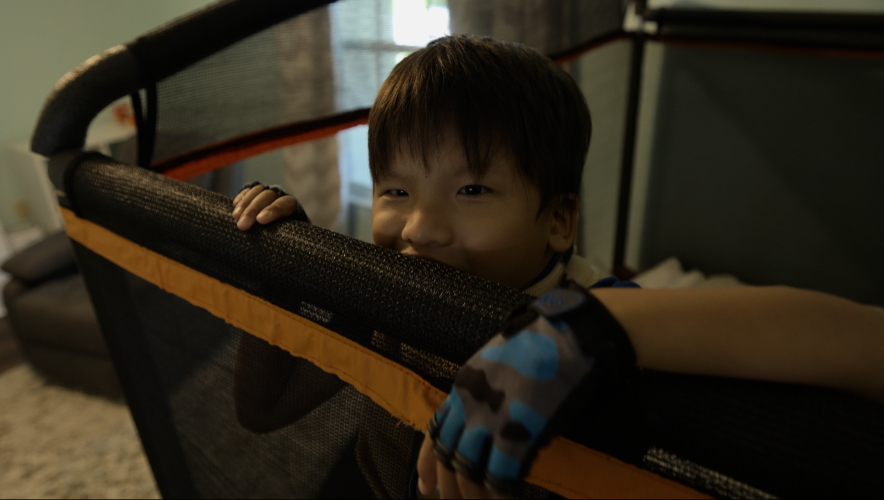


HILLSBOROUGH COUNTY, Fla. — For years, Kelli Stuart has worried about what could happen while her 11-year-old son goes to sleep.
Sawyer Stuart, who has autism, as well as a rare genetic disorder and significant developmental disabilities, has struggled with sleep throughout much of his life.
Concerned for his safety, the family converted a trampoline into a makeshift bed to help prevent injuries when he wakes during the night.
Watch report from Michael Paluska
Stuart and her husband Lee were already a family of four when they adopted Sawyer, who at the time was an orphan in China. When they arrived to meet their son, Stuart told Tampa Bay 28 reporter Michael Paluska she fell in love. But his severe disabilities also came as a surprise.
For more than a year, Paluska has reported on the health insurance crisis through the I-Team's Edward R. Murrow Award-winning series, Patient No More.
“He was very thin,” Stuart said. “Yeah, it was 2018 when we got him. I mean, honestly, I have no recollection of the first nine months that we were home. No memory; it's just wiped clean. He never slept. I mean, we really, we operated on two to three hours of sleep a night. The only way he would sleep is if one of us was standing up rocking him, and so we would take turns. But I have no memory of it, like I know it happened because I wrote it down and I have pictures, but no memory; it was just we were just in survival mode for a long time, and the sleep was the hardest part.”
The family still doesn’t know Sawyer’s exact birthday or what happened to him in his first few years of life.
“I did some detective work and found a woman in China who actually tracks Chinese orphans, and she had some information on him that we had not had before, so that was really actually super interesting, because she had a birth weight on him in May of 2018. But the file that we got from China said that he was found in July of 2018, so we actually don't know when his birthday is. I don’t think it's when they told us that it is, but that gave us a little bit more of a few more pieces to the puzzle of who he was.”
Since bringing Sawyer home to Florida, they’ve devoted their lives to helping their son thrive. Celebrating every milestone.
"His IQ is very low, you know, barring a miracle, which we believe could happen, but, barring a miracle, he most likely will never talk," Stuart said. “We just celebrate the smallest things. The other day, the dog was outside, and he went over, and he opened the door, and then he shut it back, and it was like he knew to let her in, like... and that was just a huge deal. So, just the smallest things feel like little miracles.”
Stuart tells Paluska when Sawyer was approved for Medicaid, it was a blessing. But the red tape and hoops she’s had to jump through consume her.
“It took us about five years to get him on Medicaid. Medicaid really has been such a gift for him and our family. It's just opened up doors to services, and I mean, you know, he, he's not potty trained, so we get diapers and wipes, and so in a lot of ways Medicaid has been wonderful, but Medicaid, being the parent of a child on Medicaid, is a full-time job.”
Now, Stuart is fighting to obtain insurance approval for a specialized enclosed safety bed that Sawyer's physician has described as a medical necessity. Stuart filed the request through Children's Medical Services Health Plan operated by Sunshine Health.
"One of his biggest struggles is sleep," Stuart said.
She said Sawyer often wakes up during the night in distress.
"And when he was in a regular bed, he just, he wakes up frequently, and you know…I think he has night terrors, so he wakes up in this kind of rage, thrashing, banging his head, inconsolable, and so there were a lot of nights where he would get up, and he would just be banging his head on the floor, which is just, you know, it's so dangerous," Stuart said.
As Sawyer has grown, the family has continued searching for ways to keep him safe, particularly while he sleeps. Stuart said the trampoline bed they currently use is no longer meeting his needs.
"I'm always worried, you know, what if he can't breathe? What if his head slips through? So there is always still this, this fear of him not being safe while he sleeps," she said.
Through Medicaid, Stuart sought approval for a Cubby Bed, an enclosed safety bed designed for individuals with certain medical and developmental needs. She said the request was denied three times through Children's Medical Services Health Plan, which is operated by Sunshine Health.

According to denial documents reviewed by Paluska, the requests were denied because the bed was determined to be "not medically necessary.”
Sawyer's physician submitted a letter supporting the request and describing the bed as a medical necessity.
"I think where it gets frustrating is when it feels like we're not being heard," Stuart said. "If you just look at it on paper, it's like, well, why, why would he need that bed, but if you, if you see him, and you spend time with him, and you realize this is an 11-year-old who looks like a four-year-old who acts like a one-year-old, it just makes so much more sense.”
Stuart also objected to recommendations referenced in denial documents.
"The letter this year frustrated me a little bit, because one of the things that they said is that we didn't prove that we tried everything that we could, and they suggested, like, putting reverse locks on the doors and locks on the windows and alarms, and so they said that, but then in their next bullet point they said, you know, a child, a bed shouldn't be used to restrain a child or punish him, and I'm like, but you just told me to put reverse locks on his door and lock him in his room, like that, that seems less safe to me than putting him in a sensory safe place where he cannot harm himself," Stuart said.
In a statement, Sunshine Health told Paluska:
Sunshine Health's top priority is ensuring our members receive the care and services they need to support their health, safety, and well-being. We are committed to providing families with clear information and support, and when questions come up about coverage, we work directly with members to help them understand the options and resources available for their specific health needs.
Caleb Polley, CEO of Cubby Beds, tells Paluska its products have helped thousands of families nationwide.
"Across the country, Cubby Beds have helped more than 17,000 families create a safer, calmer sleep environment at home," Polley said in an email when we reached out about Stuart's story.
“When Paluska asked what advice it would offer families facing insurance denials, Polley said.
"First, our hearts go out to her. Wanting your child to sleep safely is the most natural thing in the world, and a second denial after everything she's already done is exhausting. The system can be very hard to navigate."
Polley also explained why Florida is falling behind when it comes to coverage.
"In Florida specifically, approvals for enclosed safety beds are still limited today. That's a reflection of older coverage policies rather than the medical need, which is well-documented. Many of these policies were written before this category of bed existed, so the framework simply hasn't caught up yet. We're actively working with payers and other stakeholders in Florida to update how these beds are covered, so more families can get the care they deserve."
Stuart has requested a fair hearing and said she has contacted state lawmakers for assistance as she continues to appeal the denials.
"I want parents to know that it's okay to keep fighting, to keep pushing."
Stuart is now reaching out to legislators across the state for help, including her local representative.
Representative Karen Gonzalez Pittman sent Paluska a statement regarding Stuart’s situation:
This is a classic example of managed care plans practicing medicine. The managed care plans are not doctors and do not have a license to practice medicine, and they need to do better for the people of Florida. My office responded to the family and contacted AHCA to try to help. We were told the family has to go through the plan’s internal appeal process. That may be the current process, but it does not make this denial right.
When a doctor prescribes a bed for a developmentally disabled child, the plan should not be standing in the way and calling it unnecessary. I think this denial is shameful.
I have been vocal in committee before that plans need to step up, do the right thing, and make sure patients get the care their doctors say they need.
"We want nothing more than for him to know that he's happy, healthy, and loved. That's what we're looking for," Stuart said.
Share Your Story with Michael

A lot goes into the price of paradise and Michael Paluska focuses on every aspect. From the job market and housing to how Florida’s growth impacts our state’s wildlife. Send Michael tips to keep these important conversations going.
.

Pasco County mom of 5 takes in 3 children left without food or power whose mother faces neglect charges
Jasmine Young, a mother of 5, opened her home to three neglected girls as their mother faces child neglect charges for leaving them without food, power or water.
