

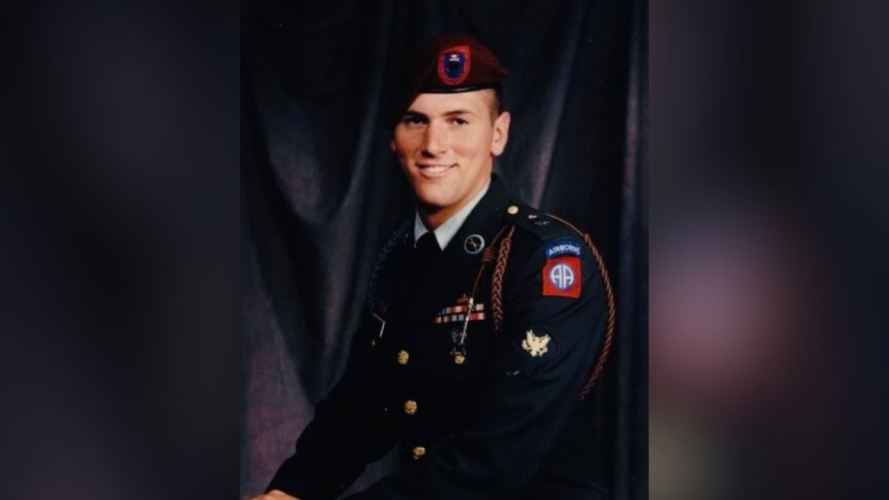


TAMPA, Fla. — As the United States marks 250 years of independence, some veterans say the battles they face after military service can be just as difficult as those fought overseas.
Army veteran Travis Horn is among those participating in a Florida-funded study examining ketamine therapy as a treatment for mental health challenges facing veterans. Horn recently underwent his fifth infusion at Complete Ketamine Solutions Tampa, a local clinic participating in the research.
WATCH: Life after war: A veteran’s journey to find relief in ketamine therapy as program faces cuts
Horn, a veteran of the first Gulf War and a member of the 82nd Airborne, described the treatment as transformative.
"It’s a near religious experience," Horn told Tampa Bay 28 reporter Michael Paluska as Paluska watched him receive his fifth ketamine treatment.
Horn told Paluska that it helped him process grief and reconnect with memories of loved ones. In family photographs, Horn is now the sole surviving brother after losing his two siblings to cancer.
"You feel like you're in the presence of sometimes the people that you've loved, and/or that you're near them somehow," Horn said.
Before receiving treatment, Horn explained what he believes makes the experience different from traditional therapies.
"Here’s where you know you are able to divorce yourself from the pain and focus on what’s on your mind," Horn said.
Researchers and veteran advocates are increasingly studying ketamine as a potential treatment option for conditions including depression, post-traumatic stress disorder and suicidal ideation. According to the U.S. Department of Veterans Affairs, more than 6,000 veterans die by suicide each year.
The growing interest in treatments such as ketamine recently received national attention when President Donald Trump signed an executive order aimed at reducing barriers to accessing certain alternative therapies, including ketamine.
Michael Hartford, a Navy veteran and program adviser with the Mac Parkman Foundation, a nonprofit focused on preventing veteran suicide, said the treatment remains under study but believes current approaches have not significantly reduced veteran suicide rates.
"So the ketamine therapy, although it's not evidence-based at this point in time, it's evidence-informed," Hartford said.
Hartford pointed to decades of persistently high suicide rates among veterans.
"And if we look at the veteran population over the last 20 years, veteran suicide rates have not changed," Hartford said.
“We’re celebrating 250 years, and our soldiers have been sacrificing their lives to protect us for 250 years from the very beginning. How can we celebrate if we don't give them a chance to live out their lives after they serve?” Paluska asked.
"Spot on, Michael. And one of the things that we, as a nation, have done is take care of our veterans as much as we possibly can. My position, and I think Mac Parkman's position, is that I believe that we are treating the symptoms, not the underlying cause of why veterans have mental health challenges, why they have suicidal ideation," Hartford said.
Hartford argues that conditions such as traumatic brain injuries and other combat-related trauma deserve greater attention as part of veteran mental health treatment.
He also emphasized what he sees as a national responsibility to care for veterans after their service ends.
Horn believes ketamine therapy could help many veterans who have struggled to find relief through conventional treatments.
"This therapy helps you kind of open up your mind, and they're in fact saying things like it helps your brain create new pathways and regenerates the brain in some regard, and that's research that's ongoing right now," Horn said. "We’ve done the conventional therapies to sit around in a, in a kumbaya, hold hands kind of setting, and I'm not saying that that's not part of it; it shouldn't continue to take place, but this is really, from my perspective, a more substantive way to help the brain heal itself."
After his latest treatment session, Horn recorded a video message describing the experience.
"Post-therapy session, just collecting your thoughts, and it is really difficult to convey to someone what the experience is like unless you try it for yourself," Horn recorded on his cell phone.
Despite growing interest in the therapy, the future of the study remains uncertain. Funding for the program is secured for only one more year.
Hartford said organizers have been notified that the program was not approved for funding in the next fiscal year.
"Unfortunately, we've been informed that we have not been approved for the next fiscal year. We have submitted a request for bridge funding for the next fiscal year, and we continue to work on exploring ways that we can get funding through either the state of Florida or other philanthropic organizations that are passionate about taking care of our veterans."
For participants such as Horn, the stakes extend beyond the fate of a single program. They involve finding new ways to address the invisible wounds many veterans continue to carry long after their military service has ended.
Share Your Story with Michael
A lot goes into the price of paradise and Michael Paluska focuses on every aspect. From the job market and housing to how Florida’s growth impacts our state’s wildlife. Send Michael tips to keep these important conversations going.
.

Pasco County mom of 5 takes in 3 children left without food or power whose mother faces neglect charges
Jasmine Young, a mother of 5, opened her home to three neglected girls as their mother faces child neglect charges for leaving them without food, power or water.
