

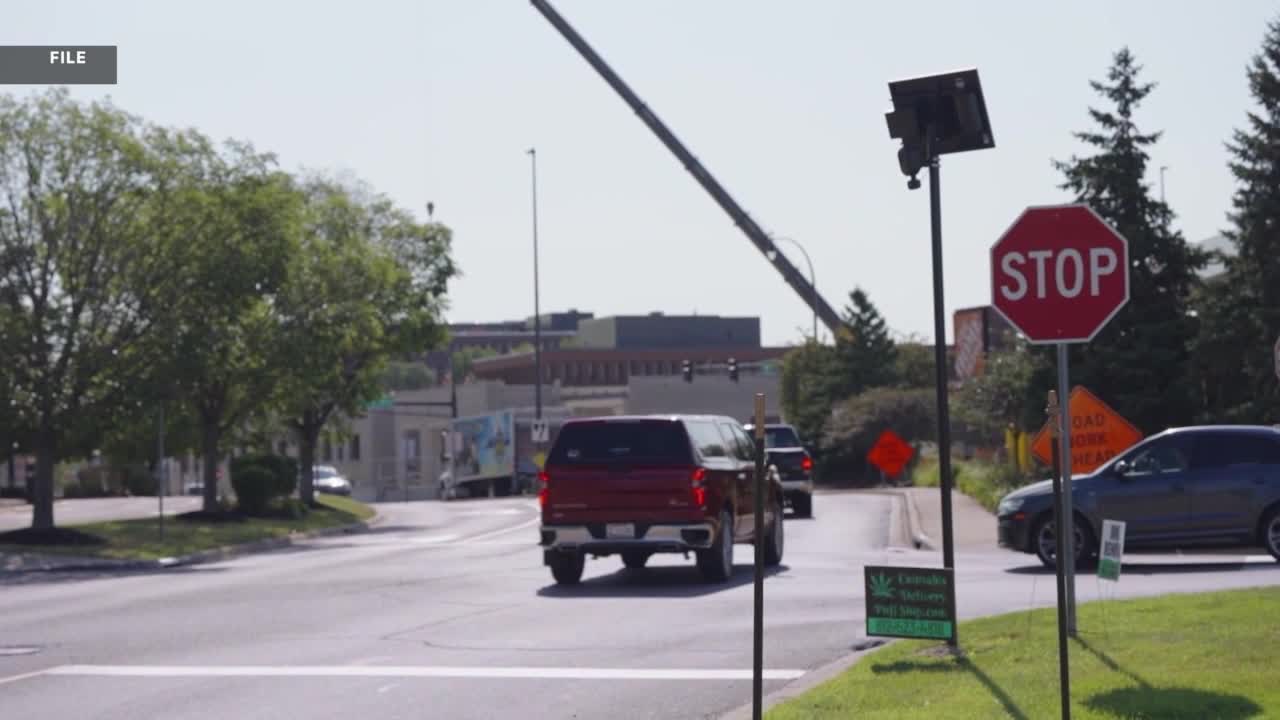


TAMPA, Fla. (WFTS) — Automated License Plate Reader (ALPR) cameras, such as Flock, are off Florida state highway rights-of-way as of today, but the controversial license plate readers are far from gone.
On Aug. 31, the Florida Department of Transportation directed agencies to remove automated license plate readers from state highway rights-of-way by Sept. 30.
The deadline applies only to cameras on state-owned property near highways. Cameras on other roads are not affected.
WATCH: ALPRs are gone from Florida state roads, but remain elsewhere across Tampa Bay
Gov. Ron DeSantis said the cameras raise serious privacy concerns.
"It's really none of the government's damn business if you're doing that, right? I mean, like, let's just be clear," DeSantis said.
Flock Safety confirmed the cameras are being relocated or removed on schedule.
"Flock is working with agencies and is on track to have all LPR cameras relocated or removed by the deadline," Flock Safety said.
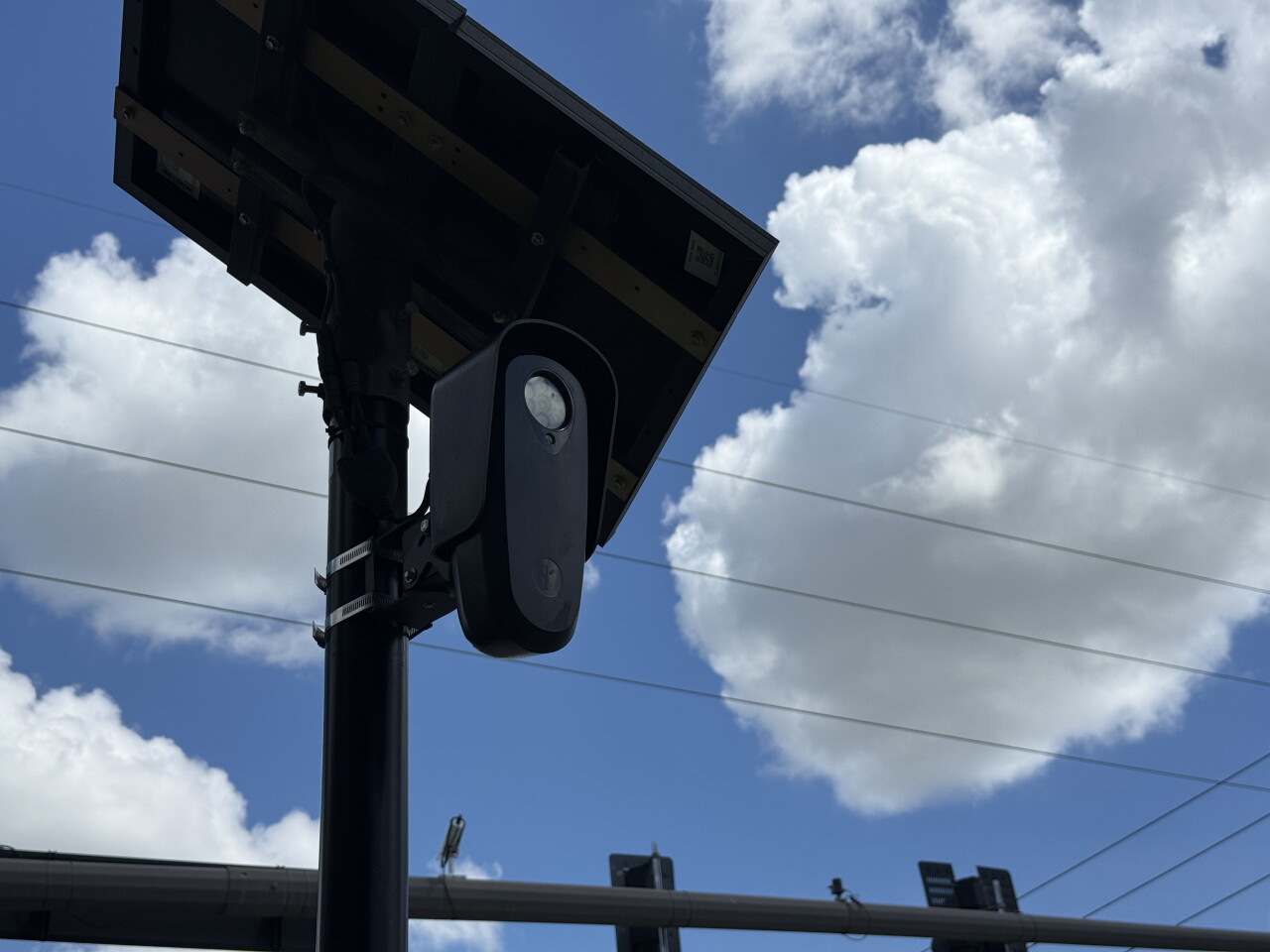
Multiple agencies across the Tampa Bay region confirmed compliance with the directive. The Tampa Police Department, Hillsborough County Sheriff's Office, Lakeland Police Department, Pasco County Sheriff's Office, St. Petersburg Police Department, the City of Sarasota, and Polk County all confirmed their cameras have been removed or are in the process of being taken down from state highway rights-of-way.
The Tampa Police Department said it removed all 17 ALPRs located within the right-of-way of a road on the State Highway System within the 30-day timeline outlined in the FDOT memorandum. Acting Chief Brett Owen said the technology has been a meaningful public safety tool.
"Tampa is one of the safest cities of our size in the nation because of outstanding police work and because we have built trust with our community through collaboration and transparency," Owen said.
"ALPRs are an important investigative tool and have assisted in solving homicide and robbery cases as well as in locating missing people in our community. We will continue to evaluate new technologies with our ongoing focus on community trust, strict oversight, and transparency, ensuring Tampa remains one of the safest and most collaborative cities in the nation," said Owen.
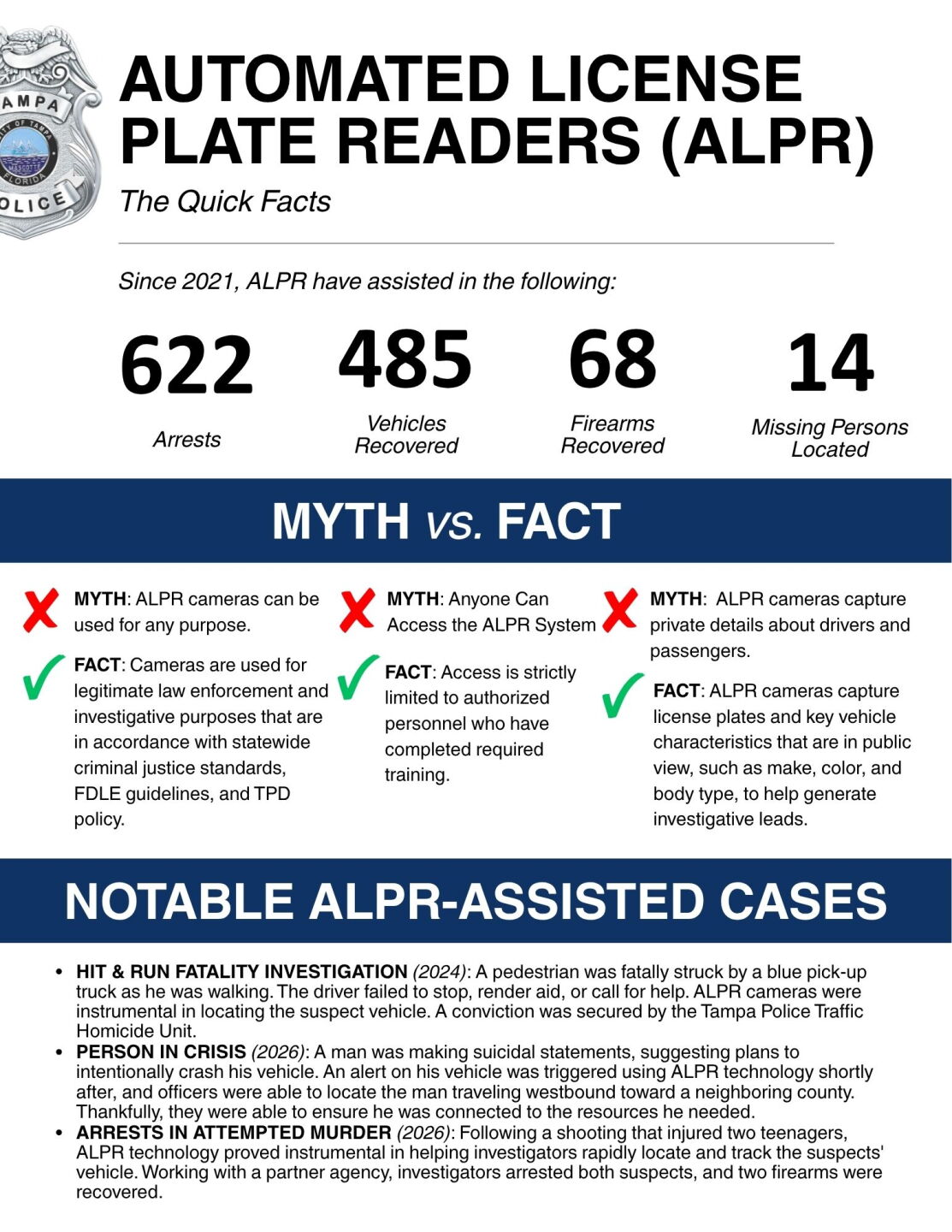
Tampa police said access to ALPR data is limited to personnel who serve in an investigative role and have a legitimate law enforcement need.
Since 2021, ALPRs have assisted Tampa police in 622 arrests, the recovery of 485 vehicles, the recovery of 68 firearms, and the location of 14 missing persons.
The technology has also played a role in notable cases.
In 2024, ALPR cameras were instrumental in locating a suspect vehicle after a pedestrian was fatally struck by a blue pickup truck whose driver failed to stop, render aid, or call for help.
A conviction was secured by the TPD's Traffic Homicide Unit.
In 2026, ALPR technology helped officers locate a man in crisis who was making suicidal statements and suggesting plans to intentionally crash his vehicle.
Officers were able to connect him to the resources he needed. Also in 2026, following a shooting that injured two teenagers, ALPR technology helped investigators rapidly locate and track the suspects' vehicle.
Working with a partner agency, investigators arrested both suspects and recovered two firearms.
The Pasco County Sheriff's Office said it no longer has access to Flock at all, with approximately 70 cameras throughout the county in the process of being removed by the vendor.
The St. Petersburg Police Department said three of its five cameras slated for removal have been taken down, with the remaining two disconnected but still on poles, awaiting removal by Flock.
The Citrus County Sheriff's Office said it has never had a contract with Flock Safety. The agency said it has used ALPR technology through Vigilant since 2019 and, more recently, Axon.
Citrus County Sheriff Vincent ordered the suspension of all sheriff's office-operated ALPR technology effective Aug. 31, 2026.
Before the suspension, the agency used fixed Vigilant ALPRs at three locations, two mobile ALPR trailer units, and 16 Axon in-car ALPR systems installed in patrol vehicles. The in-car systems were implemented in May 2025 as part of the agency's Body-Worn Camera Program.
Drivers in Tampa, Hillsborough County, Pinellas County, and Pasco County should not assume Flock cameras are disappearing from the region. The FDOT order covers only cameras on state roads and state rights-of-way. Cameras on county roads, municipal roadways, and private property are not affected by the same order.
The Pinellas County Sheriff's Office plans to remove cameras covered by the state order, but has indicated it does not intend to make a broader change to its ALPR program.
Tampa police plans to comply with the order while continuing its broader camera program.
The Hillsborough County Sheriff's Office said it will comply with the order without announcing a larger change to its ALPR program.
St. Petersburg police plans to remove affected cameras on state roads, but has not announced a broader elimination of its system.
Privacy advocates say the broader use of the cameras still warrants scrutiny. Brock Mangus, a member of the Florida Digital Rights Association, said the cameras raise concerns about digital and privacy rights.
"I think there's a lot of really good things that are happening in the state of Florida, but also there's a lot of things that have been happening that are wrapped in the guise of public safety that may infringe on our digital rights and privacy rights as citizens," Mangus said.
Mangus said the public safety pitch behind the cameras is an easy sell to lawmakers.
"It's a very easy sell to politicians, quite frankly, to say, 'Hey, look, we're going to stop speeders. We're going to stop potential hazards on the road, but I think good old-fashioned policing beats digital solutions any day still when it comes to the potential challenges,'" Mangus said.
The cameras also raise Fourth Amendment questions. The Fourth Amendment protects people from unreasonable searches and seizures.
Traditionally, if police wanted to search someone's home, vehicle, or personal property, that constitutional protection generally required some combination of probable cause, a warrant, or a recognized exception.
ALPR systems can record a vehicle's license plate information, date and time, location, make and model, color, and other identifying characteristics and make that information searchable by law enforcement.
A single photograph of a license plate may not seem particularly intrusive, but a record of hundreds of photographs over weeks or months could allow the government to reconstruct where a vehicle traveled, when it traveled there, and how frequently it returned to particular locations.
The U.S. Supreme Court has already addressed how technology can change the constitutional analysis of government surveillance.
In United States v. Jones, the court considered GPS tracking and the Fourth Amendment. In Carpenter v. United States, the court addressed the government's acquisition of historical cell-site location information and recognized that long-term location information can reveal an intimate picture of a person's life.
ALPR technology raises a related question: whether a long-term record of where a vehicle travels becomes constitutionally protected location information.
Pinellas County Sheriff Bob Gualtieri said there is no constitutional violation, comparing the cameras to a person taking a photo on their phone.
A local Tampa law firm, however, said the cameras present a gray area when it comes to the requirements of probable cause, a warrant, or a recognized exception.
The law firm said that if a criminal investigation began with an ALPR alert, key questions include whether the plate was correctly identified, who conducted the search, how long the information was retained, whether the search was connected to a legitimate investigation, and whether law enforcement had the constitutional authority to obtain and use the information.
The firm also noted that an ALPR alert does not automatically answer every constitutional question concerning a later traffic stop or vehicle search, and that if an allegedly unlawful search or surveillance activity led police to discover additional evidence, the admissibility of that later evidence may need to be examined.
The debate over ALPR technology is expected to expand beyond the removal of cameras from state roads. Future legal and policy battles are anticipated to involve data retention, public records access, interagency data sharing, federal access, private property cameras, warrants and subpoenas, facial recognition and artificial intelligence, digital search warrants, Fourth Amendment challenges, accuracy and false alerts, and rules governing historical searches.
As of today, some cameras have come down, some have been relocated, and many more still remain on roads across the region.
Here is what each agency told us:
- Flock Safety: "Flock is working with agencies and is on track to have all LPR cameras relocated or removed by the deadline."
- Polk County Sheriff's Office: In compliance with removal order.
- Tampa Police Department: "All of our ALPRs located within the right-of-way of a road on the State Highway System have been removed in compliance with FDOT notice."
- Hillsborough County Sheriff's Office: "All of the cameras have been removed from the rights-of-way."
- Lakeland Police Department: "We have taken all the necessary action to be in compliance with State of Florida directives, and the affected cameras have been removed."
- Pasco County Sheriff's Office: "PSO no longer has access to Flock. We previously had approximately 70 cameras deployed throughout Pasco County, which are in the process of being taken down by the vendor. The vendors will have more information about their process of removing the cameras."
- St. Petersburg Police Department: "Of the five Flock cameras that were slated for removal, three have been removed and the remaining two have been disconnected. Those two are still on poles and it is Flock's responsibility to remove them."
- Citrus County Sheriff's Office: "The Citrus County Sheriff's Office has never had a contract with Flock Safety and does not have access to privately owned Flock camera systems or the data collected by those systems. ALPR systems operated by private businesses or individuals are privately owned, and decisions regarding their continued use remain with those owners. Historically, CCSO has utilized ALPR technology through Vigilant since 2019 and, more recently, Axon. Based on the latest information and direction regarding ALPR systems, Sheriff Vincent ordered the suspension of all CCSO-operated ALPR technology effective August 31, 2026. Prior to the suspension, CCSO utilized fixed Vigilant ALPRs at three locations within the county, two mobile ALPR trailer units that could be deployed based on operational needs, and 16 Axon in-car ALPR systems installed in patrol vehicles. The in-car systems were implemented in May 2025 as part of the agency's Body-Worn Camera Program. ALPR technology has historically served as an investigative and public-safety tool for the Sheriff's Office. However, Sheriff Vincent has directed that CCSO discontinue its use of these systems moving forward."
- City of Sarasota Police Department: "All cameras within state highway rights-of-ways in the City of Sarasota have been removed."
Share Your Story with Jada

Jada Williams is focused on the issues that matter most to people in who live in Tampa and West Hillsborough County. From downtown Tampa to Town ‘n’ Country and Westchase, Jada works to bring you updates and solutions on everything from crime to infrastructure. Reach out to Jada below with your concerns for your neighborhood.
.

Bradenton community responds after 20-year-old volleyball star dies from disease that affects 2 in a million
The 20-year-old IMG Academy volleyball star and Under Armour All-American died Sept. 16 after a three-month battle with the rare blood disorder — even though doctors had found her a 100% bone marrow match, her mother, Tanya Mack tells Tampa Bay 28 reporter Haley Zarcone.
