



TAMPA, Fla. (WFTS) — CAIR-Florida is preparing for the possibility that it may have to stop operating in Florida this week as a federal judge considers an emergency request to block the state’s designation of the organization as a “domestic terrorist organization.”
The Council on American-Islamic Relations and its Florida chapter are challenging the designation in federal court. The dispute centers on HB 1471, a Florida law that took effect July 1 and created a state process for designating domestic and foreign terrorist organizations.
Watch report from Jada Williams
The law authorizes Florida’s Chief of Domestic Security to make a designation if statutory requirements are met. It requires written notice and gives the governor and Cabinet authority to approve or reject the designation by majority vote.
On Sept. 29, Gov. Ron DeSantis and the Florida Cabinet voted to designate more than 90 groups as terrorist organizations, including CAIR. The CAIR designation is scheduled to take effect Nov. 5.
CAIR and CAIR-Florida dispute the designation.
Ashley Gorski, senior counsel with the ACLU’s National Security Project and an attorney representing the organizations, told Tampa Bay 28's Jada Williams Monday that they are waiting for the federal court to rule.
“We, on behalf of CAIR and CAIR-Florida, have asked a federal court to block enforcement of this law because it violates the First Amendment and due process,” Gorski said.
What happened in federal court
The U.S. District Court for the Northern District of Florida heard arguments Wednesday, Oct. 28, on CAIR and CAIR-Florida’s request for emergency relief. The ACLU asked the court to prevent the designation from taking effect or, alternatively, prevent state prosecutors from enforcing criminal penalties against the nonprofits and third parties who associate with or support them.
Gorski described HB 1471 as an “unprecedented law” and argued its potential consequences extend far beyond the designation itself.
“If the courts do not block enforcement of the law starting on November 5, our clients, CAIR and CAIR-Florida, will have to shut their doors in the state because the law’s penalties are extremely broad and they are extremely severe,” Gorski said.
HB 1471 itself has been in effect since July 1. Nov. 5 is the date CAIR and CAIR-Florida designations are scheduled to take effect.
“They are ordinary nonprofits that advocate for civil rights and religious tolerance,” Gorski said. “They provide pro bono legal representation in Florida. They hold community events. They post educational materials on social media. They do community outreach.”
The ACLU contends those activities are protected by the First Amendment.
“All of that speech, all of that protected First Amendment-protected activity, is going to be shut down on November 5 unless the courts step in,” Gorski said.
A fight over due process
A major part of the federal lawsuit concerns the process Florida used to designate the organizations.
The ACLU argues CAIR and CAIR-Florida were denied a meaningful opportunity to challenge the designation before it was approved.
Gorski said the organizations received notice from the state informing them of its intent to designate them and providing the date and time of the public meeting where the governor and Cabinet would vote.
Members of CAIR’s legal team went to that meeting intending to speak on the organizations’ behalf, she said.
“The governor would not let my colleagues speak on behalf of CAIR and CAIR-Florida,” Gorski said. “That is not due process. Due process requires an opportunity to make your case, to explain why these ordinary nonprofits are not, in fact, terrorist organizations, but we were denied that opportunity.”
Gorski also criticized the judicial-review process available after a designation.
“CAIR and CAIR-Florida don’t get their basic rights, like the right to put witnesses on the stand or to cross-examine witnesses,” she said. “Those are essential elements of due process.”
Those assertions are part of the plaintiffs’ constitutional argument. The current federal lawsuit alleges violations of the First Amendment, the Fourteenth Amendment’s Due Process Clause and the Constitution’s Supremacy Clause.
“When those rights are being violated, their First Amendment rights are being violated too,” Gorski said. “Because under the Constitution, they have a right to advocate, to provide legal representation to people, to speak out about important issues, and you can’t just shut an organization down without providing basic process.”
A court has not yet resolved those constitutional claims in the current lawsuit.
What HB 1471 does
DeSantis approved HB 1471 on April 6. The law took effect July 1.
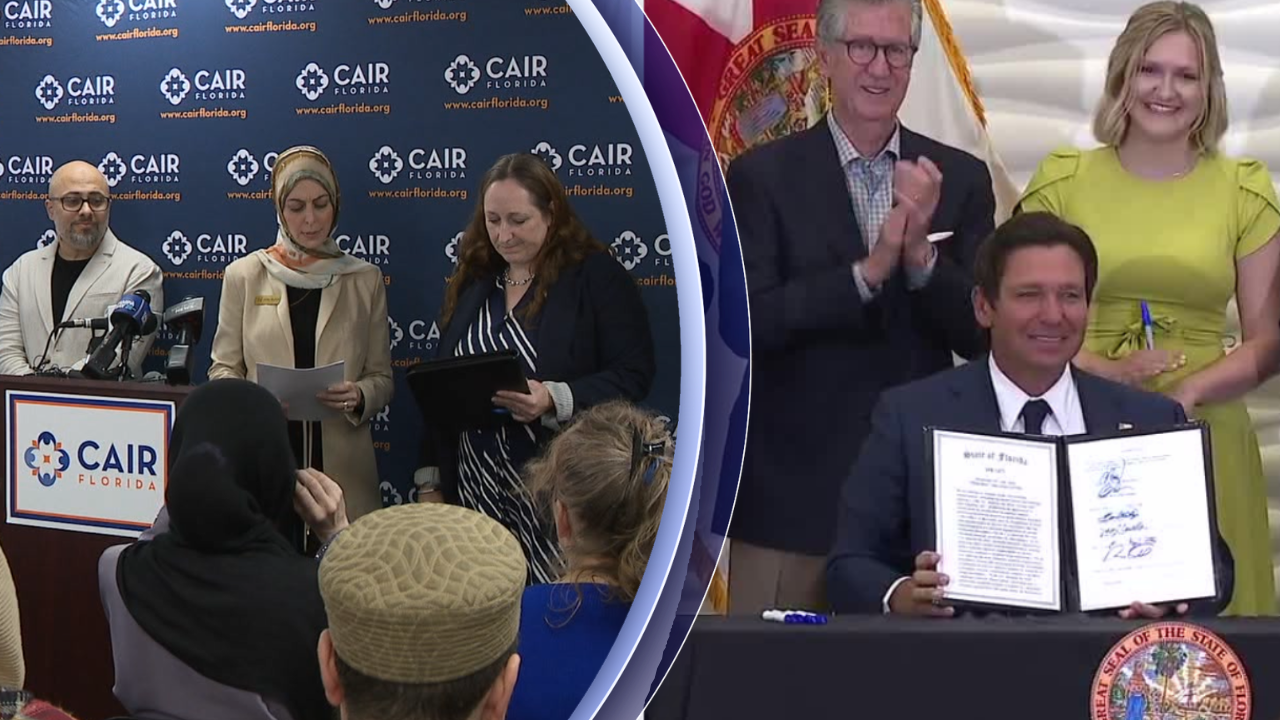
The law establishes a state process for designating organizations as domestic or foreign terrorist organizations. It also contains criminal provisions addressing people who knowingly provide, attempt to provide or conspire to provide material support or resources to a designated domestic terrorist organization.
The law restricts certain state and local government funding and support involving designated organizations. It also contains provisions affecting public schools, colleges and universities.
HB 1471 also allows the Florida Department of State to begin administrative dissolution proceedings against certain designated corporations under circumstances established in the law.
DeSantis has defended Florida’s approach.
His administration said in July that HB 1471 created a permanent statutory framework for terrorist designations, restrictions involving taxpayer-funded institutions and criminal penalties for providing material support to designated terrorist organizations.
CAIR and its attorneys dispute the state's characterization of the organization.
The ACLU says neither CAIR nor CAIR-Florida has been charged with or convicted of a crime and says the organizations do not engage in terrorist activity. Those statements are part of the plaintiffs’ position in the ongoing litigation.
CAIR-Florida prepares for Nov. 5
While the federal court considers the request for emergency relief, CAIR-Florida has already begun preparing for Nov. 5.
In a message to supporters provided to Tampa Bay 28, CAIR-Florida said it paused recurring donations on platforms it controls. It asked people who donate through automatic transfers, bank bill pay, mailed checks or payment apps to pause or cancel those payments before Nov. 5.
Gorski argues the potential consequences could extend beyond CAIR and CAIR-Florida to people who support, work for or volunteer with the organizations.
“CAIR unfortunately has to do that right now because if the courts do not intervene starting on November 5, both CAIR and CAIR-Florida, and also anyone who supports, volunteers, donates to those organizations faces extremely severe penalties for doing so,” Gorski said.
She said that concern is driving some of the steps CAIR-Florida is taking in advance of the designation becoming effective.
“To avoid those consequences, CAIR and CAIR-Florida are going to be forced to shut their doors in Florida,” Gorski said.
Asked whether an individual Floridian who continued supporting CAIR after Nov. 5 could face consequences, Gorski cautioned that she could not provide legal advice about how the law would apply to a particular person.
“Regular people who want to support CAIR and CAIR-Florida from Florida after November 5 absolutely face liability, and I can’t provide legal advice, of course,” Gorski said. “But the way this law works, it imposes extremely broad and extremely severe penalties on people for engaging in activity to further CAIR and CAIR-Florida’s interests.”
HB 1471 does make it a crime to knowingly provide, attempt to provide or conspire to provide material support or resources to a designated domestic terrorist organization. Whether particular conduct meets the law’s requirements would depend on the statute and the facts involved.
What happens next
The immediate question is whether the federal court intervenes before the Nov. 5 effective date.
“We don’t know when we will receive a decision from the court that heard argument last Wednesday,” Gorski said. “We’re hopeful that we have a decision soon.”
Nov. 5 would not necessarily mark the end of the litigation.
“Even if that decision is not in favor of CAIR and CAIR-Florida, there are possibilities of appeals, including after November 5,” Gorski said.
Her concern is what could happen if the designation becomes effective without a court order protecting the organizations.
“Without protection from the courts, starting November 5, our clients will have to end their First Amendment-protected activity in the state,” Gorski said.
She also argues the significance of the case extends beyond CAIR.
“This is unprecedented,” Gorski said. “No state in the country has a law that looks like this, and it is unconstitutional.”
That characterization is the ACLU attorney’s legal position. Gorski said other states have considered or passed laws that bear some resemblance to Florida’s in limited respects, but she argues none is as sweeping.
“Right now Florida’s is really out on a limb,” she said. “No other state has a law that looks like Florida’s.”
For CAIR-Florida, the immediate focus remains Nov. 5 and whether the federal court intervenes before its designation becomes effective.
“We don’t want to live in a country where politicians decide which organizations can be shut down without due process,” Gorski said.
Share Your Story with Jada
Jada Williams is focused on the issues that matter most to people in who live in Tampa and West Hillsborough County. From downtown Tampa to Town ‘n’ Country and Westchase, Jada works to bring you updates and solutions on everything from crime to infrastructure. Reach out to Jada below with your concerns for your neighborhood.
.
Florida brain tumor patient says nearly $1 million in medical bills are now covered after insurance denial
Five months after an insurance fight over brain surgery, Broqsten Bunt says he is medically cleared and has a zero balance on nearly $1 million in billed care.
