



A lightning strike triggered a fire that gutted the University of South Florida College of Marine Science lab on May 2, destroying the second floor and damaging what the flames did not reach with water and smoke.
Tom Frazer, Dean and Professor of the College of Marine Science, said he witnessed the cause firsthand.
"I watched the storm front kind of pass through," Frazer said. "Saw the lightning actually hit the building, so you know there's no doubt that that lightning was a contributor."
WATCH: USF College of Marine Science lab fire: Scientists save irreplaceable samples
For researchers, the initial shock was overwhelming.
"One of the staff texted me a picture of the smoke," Jay Law, a physical oceanographer and head of mooring operations at USF, said. "The whole building was just all flames, you know, so the thought then was like, man, we lost everything, you know, we're going to be not doing anything for a while while we sort all this out.”
But the team moved quickly. Once the building was safe, researchers salvaged instruments, computers and years of research — including underwater gliders, each valued at more than $250,000.
Chad Lembke, an engineer with the Center for Ocean Technology, told Tampa Bay 28 reporter Michael Paluska that the recovery of the gliders was not without close calls.
"One of them, the one that's being worked on over there, was actually open on a bench and got tossed off in the middle of the chaos," Lembke said. "Another one that was there was in the lab where the roof caved in, and it fell on top of it.”
Despite the damage, none of the gliders were lost.
Paluska toured the lab for a report in September.
"So far we have not lost any, but got to break them down completely and check the components and make sure there's no water damage or smoke damage or heat damage," Lembke said.
The gliders play a critical role in ocean research. They collect real-time data that feeds into global ocean models and supports research on red tides and marine life tracking.
"Every time that these are out, that data comes back in real time and goes into the global ocean models, as well as people looking at red tide, as well as people looking at tracking whales and fish," Lembke said.
The gliders were also central to groundbreaking research on how Hurricanes Ian and Idalia rapidly intensified — research I reported on last September, before the fire.
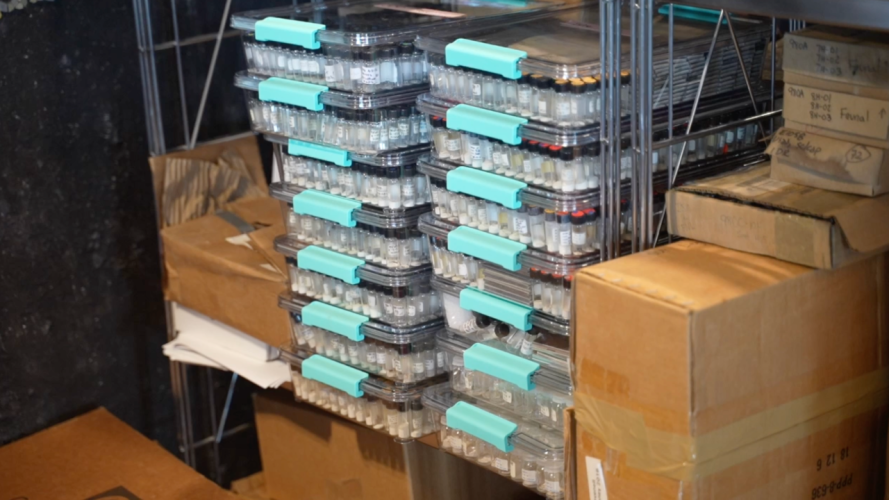
Among the most significant items saved: thousands of Antarctic samples, some more than a million years old. The samples represent an irreplaceable record of Earth's climate history and help scientists better understand rising sea levels.
"So the work that we do here is certainly local, it's regional, it's global," Frazer said. "We have a lot of people that work in the Southern Ocean, for example, so a tremendous amount of samples that have come from Antarctica. Those are more difficult to replace."
Four research teams are sharing one temporary lab — a fraction of the space they had before.
"And this lab is four labs in one that usually would be just one lab?" Paluska asked Law.
"At the moment. Yeah, we've got our glider group, which is down here," Law said.
Despite the cramped conditions, the team was operational within days.
"We were in here about four days after the fire, so we were able to, it was a lot of work to get this set up, but we were able to stay on schedule with our field program, which is really amazing," Law said.
Law said the fire dealt a major blow, but the more than 150 researchers on staff are not standing down — especially with hurricane season ramping up.
"You guys gonna make it?” Paluska asked.
"We're surviving. Again, the one thing I would just point out is that, you know, the teamwork here has been really, really impressive," Law said. "Everybody just rolled their sleeves up and got to work.”
Law said the team considers itself fortunate given what could have been lost.
"The reality is we're really, really lucky. Our group, particularly, we were able to; the Dean and his team were able to coordinate, bringing out a lot of these instruments," Law said.
This story was reported on-air by a journalist and has been converted to this platform with the assistance of AI. Our editorial team verifies all reporting on all platforms for fairness and accuracy.
Share Your Story with Michael

A lot goes into the price of paradise and Michael Paluska focuses on every aspect. From the job market and housing to how Florida’s growth impacts our state’s wildlife. Send Michael tips to keep these important conversations going.
.
'My heart breaks': Woman describes helping injured students after deadly school bus crash in Polk County
A woman on her way to work Monday morning found herself helping injured Winter Haven High School students after a school bus crash that killed two people.
