

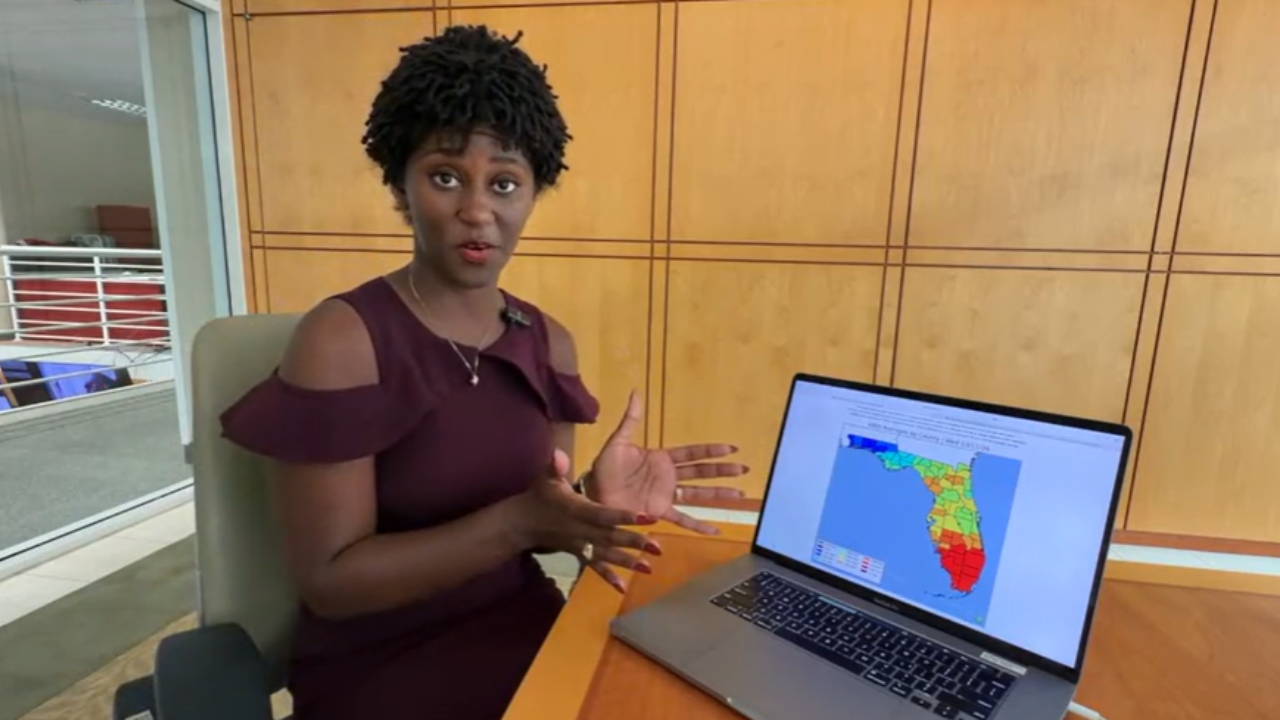


CRYSTAL RIVER, Fla. — The Citrus County Board of County Commissioners as well as the Hernando County Board of County Commissioners voted on March 10 to rescind the countywide burn ban.
Citrus County's ban was originally enacted after the Keetch-Byram Drought Index, or KBDI, exceeded 500. That index is the threshold at which Citrus County is required by ordinance to implement a burn ban. Although the KBDI later fell below that threshold, the Board elected to maintain the ban due to ongoing fire weather concerns.
WATCH: Citrus and Hernando counties lift burn bans while drought concerns persist across the broader Tampa Bay region
"We have an ordinance that we automatically go into a burn ban once the KBDI, the Drought Index, hits 500 or higher," Citrus County Fire Chief Craig Stevens said.
Conditions have since improved. The KBDI has remained below 500 since Feb. 16, 2026 according to the fire chief.
Consultation with the Florida Forest Service — Withlacoochee Forestry Center indicates improved conditions, and the Florida Forest Service Fire Danger Index currently reports low fire danger levels for Citrus County.
Meteorological forecasts also indicate increased precipitation in the coming days.
Chief Stevens said the decision to keep the ban in place even after the KBDI dropped below 500 was driven by a commitment to public safety.
"We have to think about the citizens first and their property. So we want to make sure we do the best that we can to protect them," Stevens said.
Stevens noted that drought conditions can vary across the county, with coastal areas near the Gulf typically experiencing drier conditions than inland areas like Inverness.
"The drought index in Crystal River is a little bit higher than the drought index in Inverness. However, that could change with the change of winds," Stevens said.
Fire officials also coordinate with neighboring counties and municipalities, including Hernando County, the city of Crystal River, Amherst Fire Department and Sumter County, to ensure consistent burn ban decisions across the region.
In Hernando County, officials cited a reduced number of brush fire responses in recent weeks, as well as adequate precipitation accumulations that contributed to a drop in the KBDI. The county-wide burn ban has been lifted for all unincorporated areas of Hernando County and the city of Brooksville.
Tampa Bay 28 reporter Jada Williams spent the last month closely following severe drought conditions across Hillsborough, Pinellas and Pasco. In trying to understand why Citrus and Hernando counties lifted their burn bans while others have not, she learned more about the Keetch-Byram Drought Index.
What is the Keetch-Byram Drought Index?
The Keetch-Byram Drought Index is a continuous reference scale used to estimate the dryness of soil and duff layers — that's the decomposed organic material that sits on the forest floor. The index increases each day without rain, with the rate of increase depending on the daily high temperature. When it rains, the index decreases.
The scale runs from 0 to 800. A score of 0 indicates no moisture deficit, while higher numbers reflect increasingly dry conditions. The scale is based on the assumption that saturated soil holds approximately 8 inches of moisture readily available to vegetation.
High KBDI values indicate conditions favorable for the occurrence and spread of wildfires. A prolonged drought can increase fire intensity because drier fuels burn more readily, and drying of organic material in the soil can make fires more difficult to suppress.
However, drought alone does not determine wildfire risk. Other weather factors, including wind, temperature, relative humidity, and atmospheric stability, also play a major role in determining actual fire danger.
In Florida, the Florida Forest Service calculates the KBDI by combining traditional rainfall observations with radar data from the National Weather Service's NEXRAD network. Because Florida's rainfall is largely tied to local thunderstorms and can vary dramatically over short distances, radar data helps provide a more accurate picture of precipitation across the state.
Why some rain isn't enough
A National Weather Service meteorologist told me that one of the challenges with recent rainfall is that when it comes in large amounts at once, it is difficult for the ground to absorb it all. That, combined with the fact that the driest months of the year are still ahead, means drought conditions remain a concern across the broader region.
What residents can now do
With the burn ban lifted, residents in unincorporated Citrus County may now burn yard waste without authorization, provided all required conditions are met. Yard waste includes vegetative debris generated on the property, such as grass clippings, leaves, brush, tree limbs and palm fronds.
Burn piles must be under 8 feet in diameter or contained in a non-combustible container such as a burn barrel. The following setbacks are required:
- 25 feet from wildlands, brush, or combustible structures
- 25 feet from your residence
- 150 feet from other occupied buildings
- 50 feet from paved public roads
Fires must be ignited after 9 a.m. EST and completely extinguished one hour before sunset.
Not all properties in Citrus County can meet these setbacks. If the required setbacks cannot be met, open burning is not permitted.
In Hernando County, citizens are free to resume burning within the setbacks and regulations set forth by the Florida Forest Service.
Residents in both counties are encouraged to contact the Florida Forest Service Withlacoochee Forestry Center at 352-797-4100 for questions about burn regulations or to request burn authorizations.
Never leave a fire unattended
Stevens said the most commonly violated rule is also one of the most critical: keeping a fire attended at all times.
"The biggest rule that isn't followed is making sure that that fire is attended at all times. What we see typically with property damages, whether they have an escape burn leaving their property going on to someone else's property, or damaging their own property, is typically a result of people leaving that fire unattended," Stevens said.
He urged residents to keep a water source nearby and to act quickly if a fire begins to spread.
"If it does escape like your burn area, the quicker that you can react to that the better, obviously, because if it leaves and it progresses, it gets bigger, and you're not going to be able to control it," Stevens said.
Residents should also be aware that if a fire escapes, the person responsible may be liable for the costs of fire suppression and any resulting property damage. Escaped debris burning is one of the leading causes of wildfire in Florida.
What is illegal to burn
It is illegal to burn household garbage, including paper products, treated lumber, plastics or rubber materials, tires, pesticides, paint and aerosol containers. Violations may result in citations.
Burns requiring authorization
Certain types of burning require authorization from the Florida Forest Service, including agricultural burning, silvicultural burning, land clearing burns, pile burning, acreage burning and any piles larger than 8 feet by 8 feet. To obtain authorization, contact the Florida Forest Service — Withlacoochee Forestry Center at 352-797-4100.
Outdoor burning safety tips
- Clear an area down to bare soil around the burn pile
- Burn only yard waste generated on your property
- Do not burn on windy days
- Cover burn barrels with wire mesh to prevent sparks
- Never leave a fire unattended
- Keep a water hose and/or shovel nearby
- Ensure smoke does not obstruct nearby roadways
- Fully extinguish the fire before leaving the area
Residents living within the city of Inverness or the city of Crystal River should contact their respective city offices for municipal burning regulations.
For questions about outdoor burning, contact Citrus County Fire Rescue Headquarters at 352-527-5406 or the Florida Forest Service — Withlacoochee Forestry Center at 352-797-4100.
Share Your Story with Jada
Jada Williams is focused on the issues that matter most to people in who live in Tampa and West Hillsborough County. From downtown Tampa to Town ‘n’ Country and Westchase, Jada works to bring you updates and solutions on everything from crime to infrastructure. Reach out to Jada below with your concerns for your neighborhood.
.
Bradenton community responds after 20-year-old volleyball star dies from disease that affects 2 in a million
The 20-year-old IMG Academy volleyball star and Under Armour All-American died Sept. 16 after a three-month battle with the rare blood disorder — even though doctors had found her a 100% bone marrow match, her mother, Tanya Mack tells Tampa Bay 28 reporter Haley Zarcone.
