




DOVER, Fla. (WFTS) — The sound of water flowing from Wendy Depalo's well pump is music to her ears after four grueling days without a drop of running water at her Dover home.
"This is a sweet sound, because for four days we haven't had any water," Depalo said as the pump hummed back to life Thursday afternoon. "So now you can hear the well is finally working."
WATCH: Hillsborough County families face water crisis as wells run dry during cold snap
Depalo is among hundreds of Hillsborough County residents whose wells have run dry during an unusual combination of circumstances: a prolonged cold snap that prompted farmers to increase irrigation to protect crops, coupled with one of the driest rainy seasons on record.
RELATED: What to know about water restrictions, burn bans in the Tampa Bay region
The crisis has forced families to make difficult choices and expensive adjustments to their daily routines. Depalo's household of seven people, including two elderly residents who recently returned from the hospital, had been using a bucket with a plastic bag as their toilet for four days.

"We take our toilets for granted, but that was our toilet," Depalo said, pointing to the makeshift bathroom setup. "Houses that have wells have no toilets."
Depalo reached out to Tampa Bay 28 for help. So did Stanley Shultz.
Shultz went without water even longer, from Friday through Wednesday. Six full days that tested his family's resilience and resourcefulness.
"We've been without water since last Friday. We finally got water back on this Wednesday," Shultz said. "The farmers around the area are strawberry farmers have been watering so much, and from my understanding, is a lot of these pumps take a lot of water out of our aquifer, ours included, and turn on a spigot. Nothing."
The experience was a harsh lesson in how much modern life depends on running water.
"Pretty tough. You learn really fast that the one thing you need in life is water and yes, no showers, no, no spigots, no, nothing. So it was difficult," Shultz said.
For the first three days, Shultz's family had absolutely no water access. Relief came when a neighbor stepped in to help.
"Luckily, our neighbor came over and hooked up a very large water line, hooked it up to our one spigot and kind of gave us some reverse water for two days, but, yes, three days, no water whatsoever," he said.
The complete absence of water affected every aspect of daily life.
"Nothing, nothing, no water whatsoever," Shultz emphasized when asked about cooking, cleaning, and bathing during those days.
To restore water service, Shultz had to hire a well company for an extensive and costly repair that required heavy machinery and hours of work.
"We had a well company come out, and had to drop our well a little bit, or our pump a little bit, over 20 feet more in the ground," he explained.
The repair process was a major production that left visible evidence on his property.
"Here's the track marks where the boom truck come in. And it was probably up in the air 60 feet. So here they had to pull the well out, pull all the plumbing out. Ours was 60 feet, and now it is at 80," Shultz said, pointing to the tire tracks left by the heavy equipment.
The entire process involved suspending the well equipment 60 feet in the air while workers added additional tubing and replumbed the system.
"So they pulled this whole unit out, had it suspended in the air, added more tubing to it, and then put the well back in, and then recharged everything," he said. "Probably two or three hours at least."

Despite the expensive repair, Shultz remains concerned about the long-term viability of his water supply.
"It doesn't look like our aquifer is going to recover anytime soon. Luckily, we now have water," he said.
Shultz has lived in the area for two decades.
"It has never happened in 20 years out here. We have never lost water in our well any time, and the farmers, typically, they will do some watering, but not to this extent because of our cold conditions out here that has persisted," he said.
Even with water restored, Shultz worries about what additional cold snaps might bring.
"Yes, if our temperatures drop below freezing again, the farmers start watering to save all the strawberry plants. It wouldn't be only me, but from my understanding, people down in Shrapnel area, Dover, all these people, they're having the same issues with their well pumps," he said.
There is some encouraging news from the Southwest Florida Water Management District (SWFWMD). According to Susanna Martinez Tarokh, public information officer for SWFWMD, aquifer levels are beginning to recover now that freeze protection pumping has ended.
"As of today, we have seen the aquifer level rebound approximately 31 feet from Tuesday's low point, which was the last day of freeze protection pumping," Martinez Tarokh said in an email.
SWFWMD is encouraging residents experiencing dry wells to file official complaints through their system, which can trigger investigations and assistance.
"Residents are encouraged to contact the Southwest Florida Water Management District if they are experiencing a dry well to fill out a dry well complaint form," Martinez Tarokh said.
The complaint form is available here.
District staff will investigate each complaint and work directly with homeowners to identify next steps. In many cases, wells will begin working again once aquifer levels rebound sufficiently.
SWFWMD explained the mechanics behind why cold weather creates such dramatic water shortages. During freeze or near-freezing temperatures, massive amounts of water are pumped to protect crops and fish farms, causing aquifer levels to drop temporarily.
Once aquifer levels fall below a well's pump level, the pump can burn out if it is not shut off manually or automatically by a low-pressure shut-off device. An electrical switch located on or near the well can turn off most pumps.
This process explains why so many residential wells failed simultaneously during the recent cold snap, as agricultural operations drew down the shared aquifer to protect their crops.
Anthony Halcyon, a senior environmental scientist with Hillsborough County, explained how multiple factors converged to create this water shortage.
"There's been a big increase in irrigation demand whenever there's a cold or a freeze event like this," Halcyon said. "A lot of times the agriculture industry needs to do bigger draws to preserve their crops. Unfortunately, wells like this are usually the first ones to kind of feel that effect."
The situation was compounded by an unusually dry rainy season. Despite Florida typically receiving significant rainfall from hurricanes, the 2024 season was notably quiet.
"We had a very dry rainy season, which I know that's kind of paradoxical, but we didn't get a hurricane, and that means we didn't get a whole lot of water," Halcyon explained. "No storm damage - that's the silver lining - but it does affect reservoirs, groundwater, et cetera."
Tampa Bay 28 Meteorologist Greg Dee provided crucial context about how unusual the current drought conditions are for this time of year.

MORE: Denis Phillips talks about fire danger
"We're way ahead of the pace. So seasonal drought here is typical, but usually we don't get there until April or May. This year, it's early February, and we're already seeing levels of drought that I would expect much later into the spring months, and that is concerning, as we still have a lot of dry season left," Dee said.
He explained the basic mechanics of how groundwater systems work and why they're failing now.
"The water that falls on the ground, think of the ground below us like a sponge. It literally soaks that water up, and over several hours, it does make it down toward the aquifer, moving through the soil, refilling those wells. When we didn't get enough over the summer to keep those wells full, we're now running into shortages here in the winter months," Dee explained.
The absence of tropical systems during the 2025 hurricane season plays a significant role in the current crisis.

"The main reason is we missed tropical systems. And I know we don't want to get hit by a storm, but the presence of those storms in the Gulf during the summertime months, brings more tropical moisture into Florida from the Caribbean, and that's where we get most of our rainfall. When we miss that rainfall during the summer, we really set up for trouble in the winter and spring," Dee said.
Current drought conditions are severe across the region, with some areas experiencing extreme drought.
"The biggest concern is the red. Those are extreme drought conditions. That's where you're really looking at some really dry soils. But even Pinellas and Hillsborough County, 100% of those counties are covered by drought conditions, and this is likely to get worse, as there's really no major rainfall in the forecast in the next 10 days," Dee explained.
The extended cold snap has contributed to the drought conditions in ways many residents might not realize.
"It can dry some of the soils faster. The topsoil, that's mainly because arctic air is typically extremely dry air. So as it goes over the soil, it literally just sucks all the moisture out of it. You'll notice that in your skin, when you go out on a cold day, you get really dry skin. Well, that same process is happening to the soil," Dee said.
The timing of this crisis is particularly concerning because Florida is entering its driest months of the year.

"It's crucial, but it's unlikely, because February, March and April and May are the driest months of the year, so you cannot make up a summer deficit during our winter and spring months. It's just not in the cards in a typical year. So this is only going to get worse as we head towards summer," Dee warned.
Hillsborough County is currently in a modified stage 2 severe drought, as declared by SWFWMD. This designation reflects the combination of moderate rainfall during the summer and only light rain events in the fall and winter.
According to county officials, it is not uncommon for wells to run low during times of drought and during or after cold snaps like the area is currently experiencing.
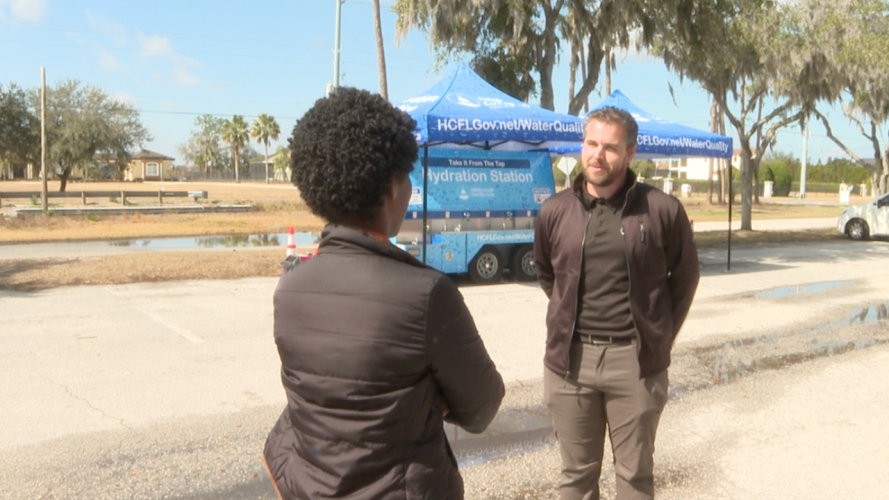
Hillsborough County has deployed its mobile hydration stations to provide relief to affected residents. London Womack, division director of plant operations, oversees the emergency water distribution effort.
"We became aware that residents in this area have been without well water, and this is our opportunity to make sure that they have access to clean water for cooking and drinking," Womack said.
The county's response began when a coworker mentioned that residents had been without water for several days, prompting immediate action to deploy the 300-gallon hydration stations.
"This was news to us, and it was like, okay, we need to jump into action," Womack said.
The water being distributed comes directly from Hillsborough County's water treatment plants, tested for safety before distribution. Residents need to bring their own containers, with one-gallon jugs working best with the station's spigots.
Following the initial emergency response, the county announced additional distribution times to serve affected residents.
Water distribution will continue at Dover District Park at Dover Sports Complex, located at 2801 Dover Park Dr., Dover, FL 33527, on Saturday, February 7 from 9 a.m. to 1 p.m. or until supplies run out.
Hillsborough County Water Resources will distribute boxed drinking water and bring its 300-gallon Hydration Station to the location. Residents should bring their own containers with lids to fill.
For residents like Shanita Armour, the water shortage brings back memories of hurricane disruptions, but with a crucial difference - there's no clear timeline for restoration.
"Reminds me a lot of the hurricane it came through," Armour said. "You know, it's nice to have well water. You know, you don't have that extra bill, but when it dries up, you're like, what do we do?"
Armour noticed the pressure dropping gradually before her well went completely dry. The economic impact has been immediate and significant.
"The economy that we're in, funds are tight, so having to go to the store every day to get water is not fun," she said.

The shortage affects every aspect of daily life in ways people don't typically consider.
"You don't realize how much you're using now - brushing your teeth, the toilets, showers, just cooking food - like you don't realize it until you don't have it," Armour said.
The financial burden extends far beyond daily water purchases. Depalo received a quote of $13,000 to drill a new well - money she simply doesn't have.
Her property houses seven people across four buildings, including elderly family members who require sanitary conditions after recent hospital stays.
The family spent nearly $100 on laundry at a commercial facility and another $40 on bottled water in a single day. They also purchased gym memberships just to have access to showers.
Relief came through community connections when a retired plumber responded to Depalo's post on the Nextdoor neighborhood app. The plumber was able to repair and prime her well pump, restoring water service.

"He answered one of my posts on the next door site," Depalo said. "So I recommend other people go on the next door side to look for his name."
The problem extends far beyond individual households. Depalo estimates that within walking distance of her property, there are eight farms, all competing for the same groundwater resources alongside growing residential communities.
"Our water can only take so much," she said. "Eight farms, plus all the people that have now moved into these communities."
Online community forums reveal the scope of the crisis. Depalo found 58 people seeking help on one neighborhood site, while a Plant City forum showed more than 300 residents dealing with similar issues.
The timing has been particularly challenging for vulnerable residents. One woman returned from the hospital after a C-section to find no water for making baby bottles or maintaining proper hygiene.
"There's one lady that just had its child c section, and she came home from the hospital find out she had no water, can't make her babies bottles, can't, you know, sanitize her hands," Depalo said.
The crisis comes as Hillsborough County prepares to implement water shortage restrictions beginning February 8. Current two-day-per-week irrigation schedules will be reduced to one day per week through July 1.

Residents can check their specific irrigation days by clicking here.
Halcyon notes that the timing of this crisis is particularly concerning.
"It is the beginning of the dry season," he said. "Typically, things start to taper off as far as being dry around late May, early June, and the peak of the drought is April. So, you know, we do have a few months to go."
While light rain fell Thursday morning, it wasn't nearly enough to replenish depleted groundwater supplies.
"I feel for the farmers, because obviously the farmers are having issues too. They lost their crop, their crops, and stuff like that," Depalo said. "But I feel for all these people that are without water."
Halcyon says agricultural operations may have different permitting procedures and variances available through the Southwest Florida Water Management District (SWFWMD) for critical business needs.
"We did all the things that we can possibly do. So we still had this situation," Depalo said. "The aquifer just couldn't handle it."
Hillsborough County Water Resources will distribute boxed drinking water and have its 300-gallon hydration station at the Dover Sports Complex on Feb. 7.
Share Your Story with Jada
Jada Williams is focused on the issues that matter most to people in who live in Tampa and West Hillsborough County. From downtown Tampa to Town ‘n’ Country and Westchase, Jada works to bring you updates and solutions on everything from crime to infrastructure. Reach out to Jada below with your concerns for your neighborhood.
.

Bradenton community responds after 20-year-old volleyball star dies from disease that affects 2 in a million
The 20-year-old IMG Academy volleyball star and Under Armour All-American died Sept. 16 after a three-month battle with the rare blood disorder — even though doctors had found her a 100% bone marrow match, her mother, Tanya Mack tells Tampa Bay 28 reporter Haley Zarcone.