



TAMPA, Fla. — Local government officials are pumping the brakes on the proposed memorandum of understanding with the Tampa Bay Rays, hinting that a new $2.3 billion stadium and mixed-use development won't move forward without serious financial safeguards for taxpayers.
The pushback is detailed in a preliminary feedback document, which outlines the government's firm responses to a working draft the Rays submitted on April 9. The coalition of government parties involved, which includes the city, the county, the Community Redevelopment Agency, and the Tampa Sports Authority, is making it clear they want stricter protections for the proposed $1 billion in public funds before any shovels hit the dirt.
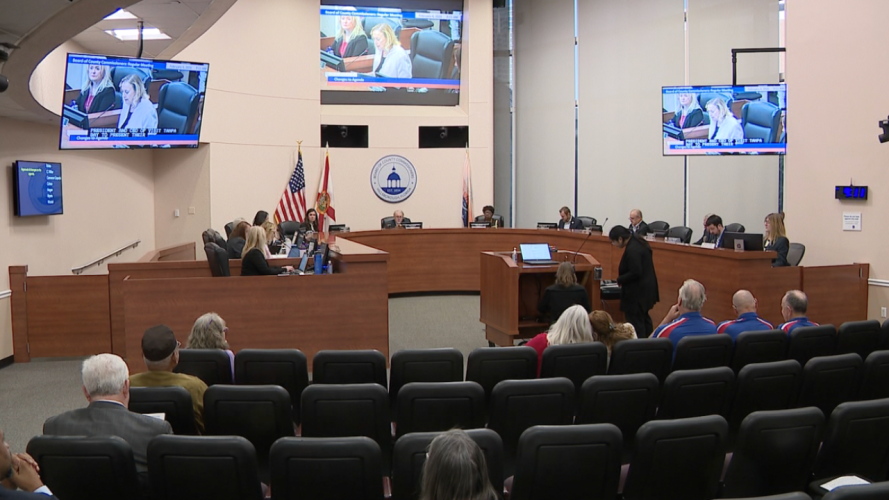
WATCH: Local government officials push back on Tampa Bay Rays stadium agreement over costs and public funding
The massive project is slated for where Hillsborough College’s Dale Mabry Campus currently sits. The goal is to open the state-of-the-art ballpark by March 1, 2029.
However, the government is outright rejecting the team's proposed timeline for getting the deal done. The Rays had suggested a highly ambitious June 1 deadline to complete all project agreements.
Local officials noted that rushing the process is simply not realistic. They estimate it will take at least 60 to 90 days to properly negotiate the complex development and funding agreements, and that clock only starts ticking once the initial memorandum of understanding is actually approved.
In response to an inquiry about the county's concerns over meeting the stadium deadline, the team issued a statement on Thursday expressing their continued commitment to the project.
"We are working diligently on the list of questions provided to us by the county and city and will share our responses with them soon," the Tampa Bay Rays said in a statement. "With the right public-private partnership, we can build a world-class ballpark by 2029 and remain focused on doing so," the team said.
A long list of questions
The government's feedback document includes a lengthy list of specific questions the Rays are currently working to answer.
Officials are asking the team to provide detailed construction drawings, a schedule for when major trade activities will occur, and estimates from contractors for site work, plumbing, and electrical. They also want to know exactly what surety or guarantees the Rays will provide to backstop public funds, and what companies they intend to use for performance bonds and letters of credit.
Additionally, the government is requesting a comprehensive parking plan that includes the proposed locations of surface lots and garages, the number of spaces, and the proposed parking rates for both game days and non-event days.
Who pays for cost overruns?
One of the most significant sticking points in the negotiations is who will foot the bill if the massive project goes over budget.
Under the proposed funding structure, the Rays would contribute $1.235 billion, while the public sector would contribute $1.001 billion. The public portion includes $750 million from Hillsborough County, $251 million from the City of Tampa, and $64 million in additional public funds.
In their feedback, officials stated unequivocally that public funding cannot exceed private funding under any circumstances. If there are construction cost overruns, the government entities say the Rays must be entirely responsible for covering every single cent of those extra expenses.
Stadium ownership and land transfer
The feedback document also sheds light on significant, non-negotiable requirements regarding the financing and ownership of the proposed stadium district.
Under the government's terms, the land for the stadium would be conveyed directly from Hillsborough College to the county. Furthermore, instead of a traditional lease agreement, the Rays would operate the facility under a 35-year license and use agreement, which includes options to extend for up to 15 additional years.
Crucially, this ensures the county retains full ownership of the stadium long after the agreement terminates. The team would also be required to sign a non-relocation agreement.
Guarding the public purse
Officials are requiring the Rays to guarantee certain funding streams to insulate taxpayers from economic downturns.
For example, the team must provide a financial backstop for Community Investment Tax funding. If growth assumptions for that tax fall below 4 percent annually, the Rays would have to make up the difference over 15 years.
On top of that, the Rays would be responsible for the debt service on Community Redevelopment Agency bonds if tax increment financing revenues (generated from the surrounding mixed-use development) fall short of initial projections.
The government parties stressed a fundamental rule for the project: public funds can only be applied to the public portions of the stadium and public infrastructure.
Maintenance and revenue sharing
The demands don't stop at construction. Officials are mandating that the Rays cover all capital maintenance expenditures to keep the stadium in top shape over the years.
In return for using the publicly owned facility, the team must either pay an annual use fee or agree to share the lucrative revenues generated from naming rights and corporate sponsorships.
Protecting the public interest
Officials took aim at specific legal language in the Rays' draft. They rejected a clause requiring the government to use "best efforts" to finalize the agreements. Instead, they stated the memorandum must be expressly non-binding to fully protect the public interest and maintain leverage.
Furthermore, government entities are demanding full review and approval authority over the design and construction of any stadium infrastructure funded by public sources. They also noted that the project must comply with all public procurement requirements.
Impact on the college and community
While the financial details are still being hammered out, the proposed project promises massive economic and community benefits.
According to project overviews, the stadium and mixed-use district are expected to generate $34 billion in direct economic impact over 30 years, creating 40,000 full-time equivalent jobs and 11,900 permanent jobs.
Hillsborough College would also see a transformative upgrade. The campus would receive brand-new academic buildings integrated into the mixed-use district, and students would gain access to direct internships and career opportunities with the major league organization. During construction, the college would temporarily relocate to a campus facility called "The Nest" to remain fully operational.
Despite the government's pushback on the initial terms, the team's leadership has previously expressed optimism about the negotiations.
"We are grateful for the collaborative efforts of Hillsborough County, the City of Tampa, and the Tampa Sports Authority, as we work together toward a shared vision for the Rays’ Forever Home in Tampa Bay," Ken Babby said in an April 9 statement.
Babby is the Chief Executive Officer of the Tampa Bay Rays.
"This Memorandum of Understanding marks an important step forward and reflects a responsible public-private partnership that can be achieved through open communication and a commitment to getting this right for the community," Babby said. "We look forward to continuing these conversations with the County, City, TSA, Hillsborough College, and the community, as we refine the plan and move the process ahead."
The City of Tampa has a workshop scheduled May 5 at 5 P.M. at the Tampa Convention Center to further discuss its role in the stadium deal.
Share Your Story with Jada
Jada Williams is focused on the issues that matter most to people in who live in Tampa and West Hillsborough County. From downtown Tampa to Town ‘n’ Country and Westchase, Jada works to bring you updates and solutions on everything from crime to infrastructure. Reach out to Jada below with your concerns for your neighborhood.
.
Bradenton community responds after 20-year-old volleyball star dies from disease that affects 2 in a million
The 20-year-old IMG Academy volleyball star and Under Armour All-American died Sept. 16 after a three-month battle with the rare blood disorder — even though doctors had found her a 100% bone marrow match, her mother, Tanya Mack tells Tampa Bay 28 reporter Haley Zarcone.
