

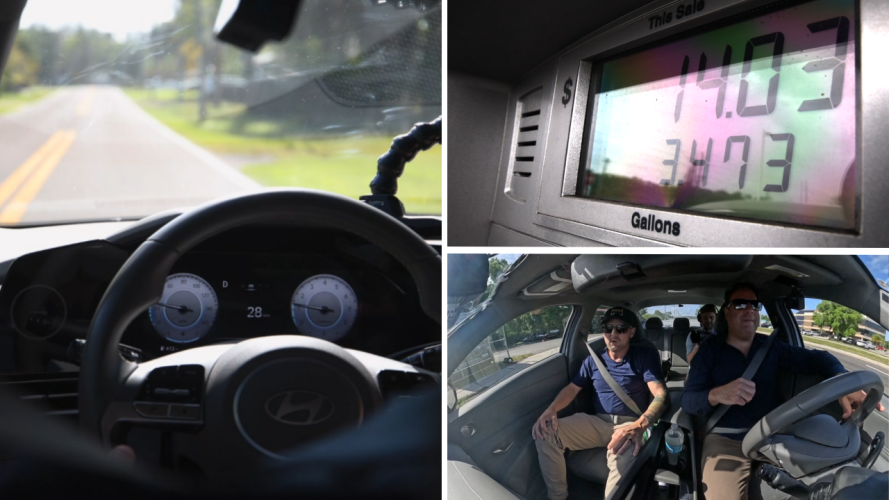


PASCO COUNTY, Fla. — Gas prices are squeezing drivers. A Pasco County driving expert shares hypermiling tips to boost fuel efficiency, save money at the pump and stretch every tank farther.
Gas prices are hammering families, with wallets and bottom lines impacted by the war in Iran. To help drivers save money at the pump, Tampa Bay 28 reporter Michael Paluska hit the streets in Pasco County with a driving expert to learn simple tricks like hypermiling.
WATCH: Gas prices surge: Hypermiling tips to squeeze every mile out of your tank
Rick Moody, owner of Good Mood Driving School, drives about 5,000 miles a month. He said all of his students ask how to drive to maximize fuel efficiency.
"It is costing us some money, so unfortunately, I've had to pass the cost on because, you know, price of Oh, man, I, you know, I just looked at the numbers. You know, we're doing about 5,000 miles a month," Moody said. "So I'm spending a lot more on gas, I was paying $30, now I'm paying like $50."
Moody emphasizes that conservative driving, specifically hypermiling, is essential for saving fuel. He recommends coasting whenever possible and driving at a steady, moderate speed. For maximum savings, he advises maintaining a speed of about 55 miles per hour, since federal data shows driving at 75 miles per hour can consume around 20% more fuel than driving closer to 60 miles per hour. On highways, Moody suggests easing up to the speed limit instead of accelerating quickly.
"Number two is this: when you're driving, just don't be in a hurry. Coast as much as possible," Moody said.
Routine maintenance, such as regular oil changes and checking the air filter, helps improve fuel economy. Maintaining proper tire pressure is equally important for maximizing gas mileage.
"The first thing is, is your, you know, your tires. Make sure they're inflated," Moody said. "Because, you know, that drag will cause you to use more fuel."
Florida gets hot, but drivers face a trade-off between using the air conditioning and rolling down the windows.
"Yeah, if you turn it up full, you know, for full, you know, full blown, it's using power," Moody said. "The other thing is, like, you know, just rolling down the windows, you create drag. So if you're gonna roll down the windows, you have a little bit of drag. Bit of drag, you know."
Another major tip is to avoid traffic whenever possible. Moody recommends keeping your GPS active at all times to help reroute around crashes and delays, even on familiar roads. When waiting at a stoplight, he suggests keeping your car in drive instead of neutral. If you anticipate being stopped for a long period, he advises turning off the engine.
"No, you just keep it in keep it in drive, keep it in drive, and that way you just keep moving," Moody said.
"Every time you idle, you're going to burn fuel. It's going to sit at zero. You know, you're not getting any miles, you're just burning through fuel. So if you're going to sit, turn off the car. Especially for my job, because, you know, my job is to drive, you know, not to sit, so we try to avoid all the red stuff as much as possible."
Moody also suggests using gas station rewards programs to maximize savings on fuel costs.
"Number three is, take advantage of those rewards that those stores give you, you know, try to get every penny off that you can, you know, five cents, 10 cents, 30 cents, you know, I'll go in and buy buy a drink, just so I can get 30 cents off my next fill up," Moody said.
As for those cars that automatically start and stop at lights, the Society of Automotive Engineers (SAE) shows that, depending on driving conditions, the fuel economy improvements of the start/stop function were between 7.27 and 26.4 percent in fuel use during testing. But many drivers are so annoyed by the function that they turn it off if they have the option.
This story was reported on-air by Michael Paluska and converted to this platform with the assistance of AI. Paluska and our editorial team veriify all reporting on all platforms for fairness and accuracy.
Share Your Story with Michael

A lot goes into the price of paradise and Michael Paluska focuses on every aspect. From the job market and housing to how Florida’s growth impacts our state’s wildlife. Send Michael tips to keep these important conversations going.
.

Pasco County mom of 5 takes in 3 children left without food or power whose mother faces neglect charges
Jasmine Young, a mother of 5, opened her home to three neglected girls as their mother faces child neglect charges for leaving them without food, power or water.
