



TAMPA, Fla. — Florida is in the grip of an extreme drought. Water restrictions, burn bans, and brown lawns have become the new normal across the state — with some areas turning into dust bowls. But in Tampa Bay, scientists say the lack of rain is producing an unexpected benefit: crystal-clear water and thriving seagrass.
This change in rainfall has had a noticeable consequence: with fewer heavy rains, less pollution is washing into the bay, allowing the ecosystem to respond in surprising ways.
Watch report from Michael Paluska
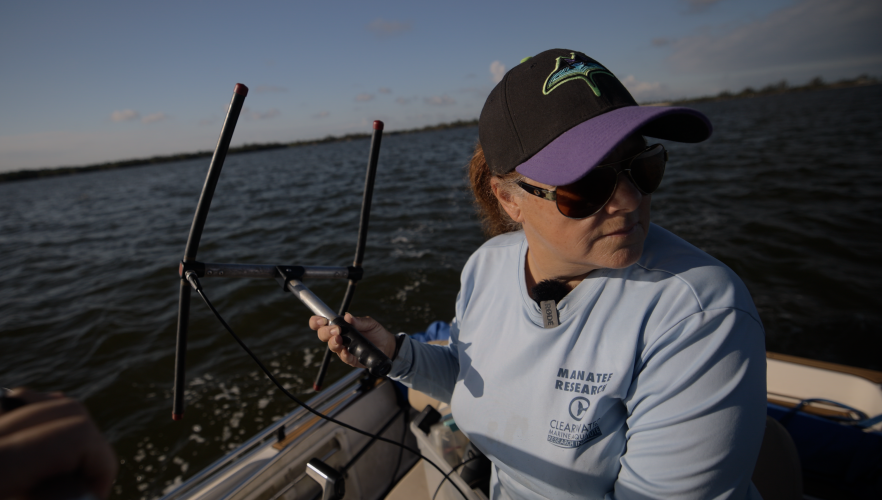
To observe these effects firsthand, Tampa Bay 28 reporter Michael Paluska joined Jennifer Galbraith, a manatee research scientist with Clearwater Marine Aquarium's Manatee Rescue and Rehabilitation Partnership, on a boat excursion.
Paluska has covered the impacts of pollution on manatees for years.
Galbraith was tracking Julian, an orphaned calf rehabilitated at ZooTampa at Lowry Park and recently released back into the wild. With a tracker beeping and spinning, she scanned the horizon for any sign of the manatee.
"Let's keep on this track for a bit, he's close," Galbraith said.
After some near misses on the open water, she finally spotted him.
"That's a crab trap," Galbraith said with a laugh.
Finally success.
"I got him, ha!!" Galbraith said.
Julian was eating seagrass and swimming alongside other manatees — all signs, Galbraith said, that were encouraging. The habitat, she said, is functioning like a buffet for wildlife large and small.
Watch Jennifer Galbraith swim with sharks to tag manatees.
"There's a silver lining to this, but at the same time it's more of a message, like, look, how much better things could be with just a little bit of work," Galbraith said.
Explaining the relationship further, the connection between drought and water clarity comes down to what is not entering the bay.
"What that tells me isn't, oh, drought's good, it's telling me maybe, maybe we should do a better job of keeping that stuff from getting in the water when it does rain, and it clearly doesn't take that long or that much effort to make that happen," Galbraith said.
Maya Burke, assistant director of the Tampa Bay Estuary Program, echoed that connection between rainfall and bay health.
“The one thing that Jen Galbraith said is, this is a message for people is... I'm out here every day, and she's like, it's beautiful. It's a message that if we don't get in the way, nature can thrive?” Paluska asked Burke.
"Yeah! "Nature's resilient, and so you know, to the extent that water quality in the bay struggles, it's mostly because of things that we're doing," Burke said. “The amount of rainfall that we receive is one of the strongest predictors of how much seagrass we have in the bay," Burke said.
Despite these improvements, Burke noted there's an important caveat to nature's resilience.
When the rainy season arrives, Burke said water quality drops sharply. The culprit, she said, is stormwater runoff.
"The most common source of nitrogen pollution in our bay is from stormwater runoff, so that's mostly from, you know, the concrete, the asphalt that we put on the ground, the houses, fertilizers that we put on our lawn. When the rain hits that, it's not able to penetrate and seep into the earth. Instead, it basically zooms off. You can think of it like a waterslide to the bay, and it's taking all of that pollution with it," Burke said.
Stormwater is not the only source. Burke also pointed to what is in the air.
"The second most common source is from atmospheric deposition, … the stuff that's coming out of your tailpipes, the stuff that's coming out of power plants," Burke said.
With the rainy season approaching, scientists caution that this period of clear water may soon end and advise visiting now. Asked if technology could maintain the bay's clarity, Burke was cautiously optimistic.
"I mean, we don't know until we try. The bay is probably never going to be completely crystal clear or look, you know, like the sparkling blue waters down in the Bahamas, but we can get pretty close," Burke said.
Galbraith reflected on the significance of seagrass loss for manatees like Julian.
“Have you had manatees that you were tracking that you found that were dead from starvation?" Paluska asked.
"Yeah. Unfortunately," Galbraith said. "Devastating, devastating."
For now, the drought is giving Julian a window of time to fatten up, learn from other manatees, and prepare for winter. Watching him surface and feed, Galbraith pointed out the telltale signs.
"That is him, but that is a clear indication he is feeding because they will do the head toss and bring that head up, so that's one of those aha moments like ok good," Galbraith said.
"Alright, checking all the boxes today, Mr. Julian," Galbraith said.
"That's a good day!" Paluska said, smiling.
"That's a good day!" Galbraith said with excitement and joy that only someone who dedicates her life to this animal can understand.
Share Your Story with Michael

A lot goes into the price of paradise and Michael Paluska focuses on every aspect. From the job market and housing to how Florida’s growth impacts our state’s wildlife. Send Michael tips to keep these important conversations going.
.

'My heart breaks': Woman describes helping injured students after deadly school bus crash in Polk County
A woman on her way to work Monday morning found herself helping injured Winter Haven High School students after a school bus crash that killed two people.
