

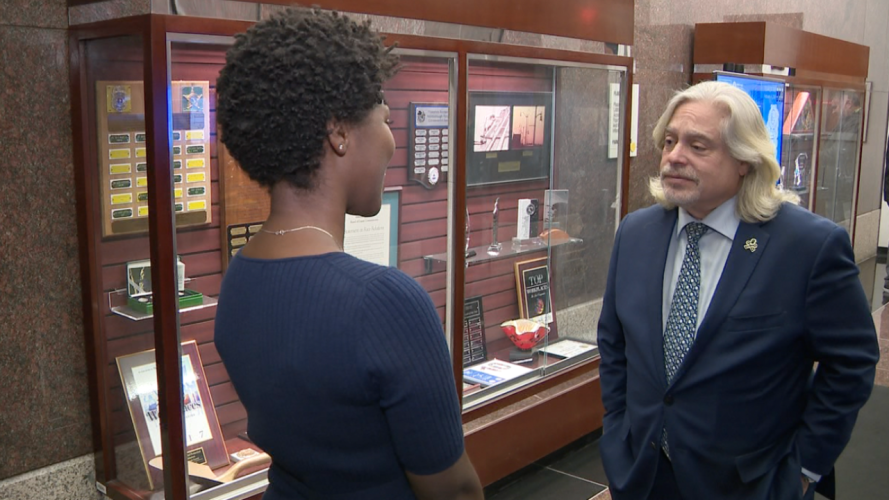


TAMPA, Fla. — Tampa Bay 28 reporter Jada Williams was at the Feb. 4 Hillsborough Board of County Commissioners' meeting where Commission Chairman Ken Hagan provided an update on the Tampa Bay Rays' plans to build a proposed $2.3 billion ballpark, mixed-use area and new campus at the Hillsborough College Dale Mabry campus.
Hagan started by acknowledging the stark difference between the current ownership group's approach and previous efforts, calling their conduct "180 degrees different" and "refreshing."
WATCH: Hillsborough County commissioners advance Tampa Rays stadium discussions despite funding concerns
"There have not been any formal negotiations up to this point," Hagan said. "While significant progress has been made over the last couple months, we have a long way to go in order to get to a place where our board can have an honest debate and discussion on what a framework or agreement would look like."
The Rays are targeting a 2029 completion date for their "forever home," which Hagan acknowledged as "quite ambitious." The ballpark would anchor a mixed-use development requiring an overall $8 to $10 billion direct investment by the team on approximately 120 acres.

Hagan compared the project to the Atlanta Braves' Battery development, calling the Rays' vision "the battery on steroids." The Tampa project would feature 6 to 8 million square feet compared to the Battery's 2 million square feet and is projected to attract nearly 10 million unique visitors annually.
"That's more visitors than attend Animal Kingdom and Hollywood Studios," Hagan said. "Just think about that for a moment."
Jada was also at Hillsborough College on Feb. 3, when Gov. Ron DeSantis pledged his support for the Tampa location. That's the first time a Florida governor has publicly backed a Rays ballpark effort.
"Baseball belongs in Tampa Bay. Baseball can succeed in Tampa Bay," DeSantis said at the event, which Hagan called "critical" to the project's success.
The Hillsborough College location was selected after considering multiple sites, including Ybor City, which was Hagan's preferred choice. However, the college campus was the only location that met all the team's criteria, primarily providing sufficient land for the entire mixed-use development.
The county is conducting an independent economic study through AECOM to verify the team's projections, including fiscal impact analysis and market demand assessments.
Hagan warned that failure to reach an agreement could result in the team's relocation, with Orlando being the likely destination. Both DeSantis and MLB Commissioner Rob Manfred referenced Orlando as "an extremely viable option" during the Feb. 3 event.
"That's not a threat, it's just reality," Hagan said. "I point that out because I think in some folks' minds, they feel the team will remain here no matter what. And that's simply inaccurate and frankly, naive."
The commission expects to receive additional information from the team before beginning work on a financial framework. Any eventual agreement would require approvals from the county commission, Tampa City Council and the Tampa Sports Authority.
Chair Ken Hagan made the motion to direct staff to continue discussions with the team and bring back a framework for board consideration. The motion passed with support from commissioners, though several expressed reservations about the potential use of CIT funds.
Commissioner Josh Wostal raised significant concerns about the use of CIT funds, citing promises made to voters during the tax renewal process. He quoted county attorney records showing commissioners previously stated the CIT would not be used for new professional sports facilities.
"We promised everyone on the public record that the CIT numbers would be ineligible for the use of new public facilities," Wostal said. "We have not even began to collect that tax, and here is a suggestion that we already deceive the taxpayers."
County Administrator Bonnie Wise outlined guiding principles for negotiations, including protecting the county's credit rating and avoiding development risk. An independent AECOM economic study is being conducted to verify the team's projections.
Commissioner Harry Cohen noted the inherent value of retaining the team, referencing potential MLB expansion fees of $2 to $2.5 billion that other cities might pay for new franchises.
"This motion gives us the opportunity to pursue something that's not available to any other major market in this country right now, which is the chance to have a major league baseball team without paying a multi-billion dollar expansion fee," Cohen said.
Commissioner Gwen Myers expressed support for continuing discussions while emphasizing that any CIT funding must be narrowly defined and not serve as the primary funding source for stadium construction.
The project would be located in the Drew Park area, where a community redevelopment agency has seen limited growth over the past 20 years. Wise noted the development would provide "a big boost to the Drew Park area" through job creation and increased tax revenue.
Santiago Corrada, president and CEO of Visit Tampa Bay, believes a potential new Tampa Bay Rays stadium could significantly boost tourism in Hillsborough County.
Speaking about Tampa's evolution as a tourist destination, Corrada spoke to Tampa Bay 28 reporter Jada Williams about the area's broad appeal across different demographics and income levels.
"The evolution of Tampa is fabulous. We have something for all tastes, all price ranges, and I think that's what makes us incredibly attractive, not only domestically, but internationally," Corrada said. "If you're a luxury traveler, we got stuff for you. If you're a family, we've got stuff for you. If you're a middle income person, we have things for you."
Regarding the ongoing discussions about bringing the Rays across the bridge to Tampa, Corrada pointed to the flexibility that modern sports facilities can offer beyond baseball games.
"If they're community players, if they engage in just not just the sport, they host concerts, they host other events that we can market and bring people to the destination, I think are critically important," Corrada said.
He pointed to Sunday's Stadium Series game, where the Tampa Bay Lightning played Boston on a rink constructed inside Raymond James Stadium, the home of the Tampa Bay Buccaneers. Corrada says that's an example of how sports can drive tourism from target markets.
"We had the Lightning facing Boston. Boston is a target market for us. We market in Boston a lot. We want Bostonians during the winter months to come and visit with us," Corrada said. "To see 65,000 people in an arena not built for hockey, and that's what I'm talking about, is how flexible the new stadium will be to accommodate collegiate sports, amateur sports, concerts, community events."
Tourism funding would likely contribute to a potential Rays stadium through the tourism development tax, similar to existing arrangements for Raymond James Stadium and Amalie Arena. Currently, one cent of the tax is dedicated to each facility.
"Tourism will pay for part of it if we get to that point," Corrada said. "I would assume some portion of another cent would be dedicated to the Rays if we get to that point."
However, Corrada stressed that successful facility development requires more than just construction.
"You build it and they will come is not reality, it's television," Corrada said. "You build it, you market it, and then they will come. So marketing has to be an integral part of any of the development."
The county has hinted at using tourism tax dollars to help fund the stadium, specifically utilizing the sixth cent of the tourism development tax. This approach mirrors the funding structure used for other major sports facilities in the region.
When asked about concerns over stretching tourism tax resources, particularly following recent commitments to the Tampa Bay Lightning, Hagan dismissed those worries.
"Not at all, because there are different cents of it," Hagan said. "The fifth cent is what we utilize for the Tampa Bay Lightning, and the sixth cent is what we will utilize for the Rays, and we have a significant capacity that we'll be able to utilize."
Visit Tampa Bay currently receives approximately 40% of all tourism tax collections, with the remaining 60% going to other county initiatives. Of the first three cents collected, the organization receives 70%. The Bucs receive the fourth cent. The Lightning get the fifth cent. The sixth cent is split among other groups, including another 30% for Visit Tampa Bay.
Corrada noted that adding Rays stadium funding could impact this distribution unless hotel development or occupancy rates increase significantly. With Tampa already maintaining a 75% average annual hotel occupancy rate, he acknowledged the challenge of further growth.
"When you look at 75% average occupancy for a year, that means three quarters of your hotel rooms are already taken. So how much more can we do?" Corrada said. "It'll take a whole lot of marketing. It'll take a whole lot of work to make sure that not only we increase those occupancy numbers, but we also work on building new hotels in Hillsborough County."
Corrada, who has worked in Hillsborough County for nearly 23 years, says marketing plays a critical role in driving both tourism and local investment.
"I have seen the power of marketing. I have seen how it drives investment. I have seen how it drives attention. I have seen how it drives not just visitors, but residents to the destination," Corrada said. "You could have the greatest product in the world, and if people don't know you have that greatest product, they're not buying it."
Hillsborough County Commissioner Ken Hagan said he expects the Tampa Bay Rays to contribute a minimum of 50% toward a new stadium.
Speaking following the Feb. 3 press conference with the governor, Hagan remained optimistic about the current ownership group's willingness to invest substantially in a potential Tampa facility.
"A minimum team's got to be in for 50% if not more," Hagan said. "It's so refreshing compared to what we experienced with the previous ownership group, and they would never commit to that. So the fact that we started negotiations with that is one of our guiding principles, I think, certainly goes a long way."
While the tourism tax won't cover the entire public portion of stadium costs, Hagan indicated the county has sufficient capacity within the tax structure to support the project.
"Certainly won't go cover everything, but that's not going to be an issue, nor will it be an issue when it comes to the Buccaneer renovations that we'll undertake here probably within the next year or so," Hagan said.
Share Your Story with Jada
Jada Williams is focused on the issues that matter most to people in who live in Tampa and West Hillsborough County. From downtown Tampa to Town ‘n’ Country and Westchase, Jada works to bring you updates and solutions on everything from crime to infrastructure. Reach out to Jada below with your concerns for your neighborhood.
.
Bradenton community responds after 20-year-old volleyball star dies from disease that affects 2 in a million
The 20-year-old IMG Academy volleyball star and Under Armour All-American died Sept. 16 after a three-month battle with the rare blood disorder — even though doctors had found her a 100% bone marrow match, her mother, Tanya Mack tells Tampa Bay 28 reporter Haley Zarcone.
