

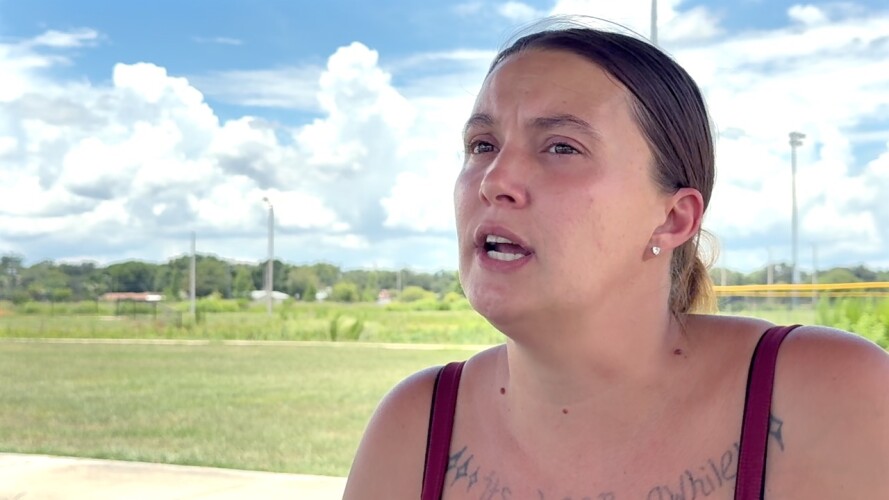


POLK COUNTY, Fla. — When Christian Hines thinks back to the rabid cat attack that sent her to the emergency room for painful post-exposure rabies shots, one memory stands out.
“Literally, I had the pillow to my face screaming,” she recalled. “My dad about ran out of the room in the emergency room getting the shots on this one.”
WATCH: Rabid cat bite victim says Polk County should rethink approach to free-roaming cats
Days ago, Hines was sitting on her back porch along Glen Road in north Lakeland when she says a cat she had known for years suddenly attacked, biting her three times.
“She got me good,” Hines said.
According to the Polk County Sheriff’s Office, Hines was one of five people bitten by the same cat, named Secret, before it was later found dead beneath Hines’ home and tested positive for rabies.
But Hines says the cat that attacked her wasn’t a stranger.
“It was my neighbor’s cat. It was a pet of hers. It wasn’t a stray,” she said. “It was a pet that we’ve all loved on.”
Still, Hines says that cat was only one of many roaming the Glen Road neighborhood, where free-roaming and community cats have long been a fixture.
Hines believes the incident should prompt the Polk County Sheriff's Office, which oversees Animal Control in Polk County, to reconsider how it addresses the area's growing population of free-roaming cats.
She supports exploring Trap-Neuter-Release, or TNR, programs, in which free-roaming cats are captured, sterilized, vaccinated, and returned to where they were found.
“I feel like that would be a better option,” she said.
She says there should also be an affordable program to help residents get neighborhood cats spayed, neutered, and vaccinated.
“People look at it like, ‘Am I going to make sure my family has a meal this week, or am I going to go try to get this stray cat neutered or vaccinated?’” she said.

Sheriff's Office rejects TNR approach
The Polk County Sheriff’s Office takes a different view.
The agency has repeatedly rejected Trap-Neuter-Release programs and argues communities should not be expected to live alongside outdoor cat colonies.
Sheriff Grady Judd has likened the idea to introducing other unwanted animals into neighborhoods.
“Would you want somebody to bring some boa constrictors to your yard? Would you want someone to bring some iguanas to your yard? Yet cats roam free,” Judd said.
In response to questions from Tampa Bay 28, the Sheriff’s Office said it does not believe TNR programs effectively reduce free-roaming cat populations.
“Feral cats are invasive and negatively affect wildlife, especially wild birds. TNR colonies attract more non-sterilized cats (that continue to breed) because of the food provided to these colonies,” the sheriff’s office wrote in a January email to Tampa Bay 28.
Instead, it says responsible pet ownership, adoption, and traditional spay-and-neuter efforts are the better long-term solutions. It also discourages people from feeding roaming cats.
Animal advocates continue pushing for change
Local animal advocates strongly disagree with the Polk County Sheriff's Office on TNR programs.
Eve Salimbene, president of the Street Cat Project of Polk County, says organizations like hers support sterilizing and vaccinating community cats before returning them to their neighborhoods because doing so prevents future litters and creates a vaccinated barrier between wildlife and people.
“If we have less cats breeding, we have less cats,” Salimbene said.
She argues everyone involved ultimately wants the same outcome.
“The county and the sheriff and our organization and the animal advocates — we’re all working toward the same thing,” she said. “We want less cats.”
Advocates have repeatedly taken their concerns to the Polk County Commission, but commissioners have often directed them to the Sheriff's Office, which oversees Animal Control.
“We have met complete resistance,” Salimbene said. “We have been shut down at every avenue that we’ve gone through.”

Rabies alert remains in effect
Following the attacks, the Florida Department of Health issued a 60-day rabies alert for the Glen Road area and has urged residents to avoid contact with wild or stray animals and to keep pets under direct supervision.
The Sheriff’s Office also cited the woman it says had been feeding the cat, accusing her of negligence and failing to vaccinate the animal.
For Hines, the experience has only reinforced her belief that more needs to be done.
“When you’re talking about cats, you’re talking about an animal that can literally have a set of kittens and in that same cycle have another set of kittens,” she said. “I think you probably wouldn’t get rid of that problem by opening that program up, but you would cut back on, you know, there being so many.”
Ultimately, Hines says she's open to any approach that meaningfully reduces the number of free-roaming cats. While she believes expanding access to Trap-Neuter-Release programs could help, she says if county leaders instead believe trapping and euthanizing cats is the answer, they need to do it effectively enough to actually reduce the population.
“[Cat overpopulation is] becoming a huge problem,” she said.

Bradenton community responds after 20-year-old volleyball star dies from disease that affects 2 in a million
The 20-year-old IMG Academy volleyball star and Under Armour All-American died Sept. 16 after a three-month battle with the rare blood disorder — even though doctors had found her a 100% bone marrow match, her mother, Tanya Mack tells Tampa Bay 28 reporter Haley Zarcone.
