

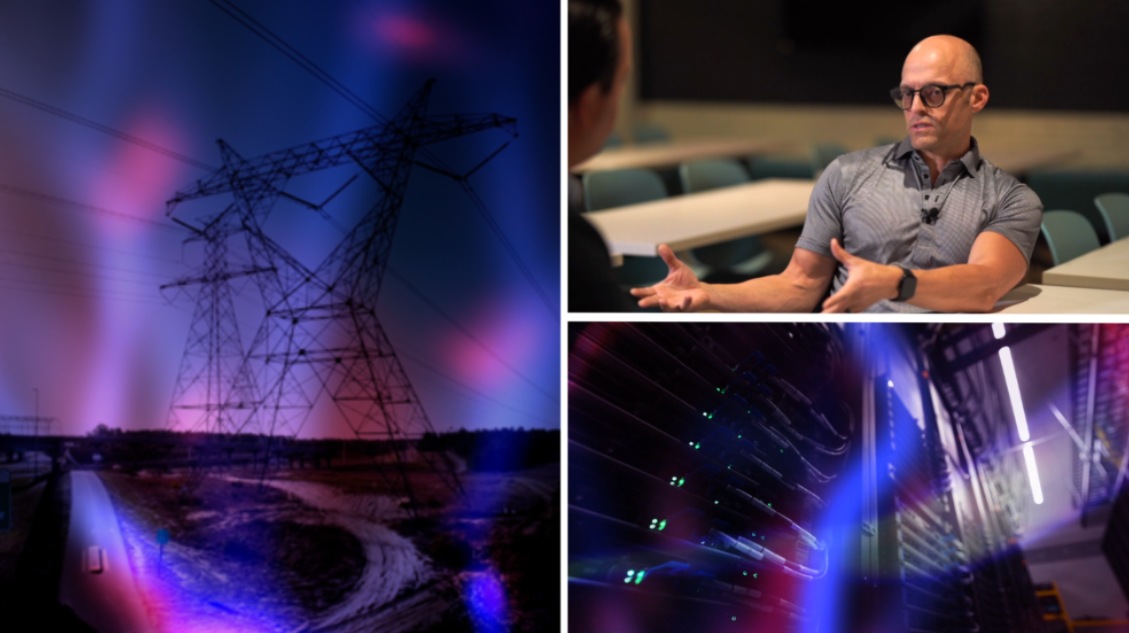


TAMPA, Fla. — Florida faces a critical debate as the rapid expansion of AI data centers prompts widespread concerns about energy, the environment, and communities, with startups proposing innovative solutions to address these challenges.
Florida communities are pushing back against proposed hyper-scale artificial intelligence data centers, worried about the strain on power, water, and the environment — while state leaders and entrepreneurs race to get ahead of the boom.
Watch report from Michael Paluska
Data centers that power artificial intelligence never shut down. According to the International Energy Agency, a typical AI-focused data center consumes as much electricity as 100,000 households — and the largest ones currently under construction will consume 20 times as much.
One estimate shows that searching ChatGPT consumes 10 times as much energy as a traditional Google search.
Shawn Cutter, founder and CEO of EnergiAcres, said his startup is working on solutions to data center problems in power, water, and food supply.
"AI has just started touching our lives," Cutter said. "And so that is the compute stack that will never be turned off. Like, what we're building is infrastructure that is always on forever.”
Cutter said his company's vision centers on repurposing data center output rather than simply extracting from the grid and surrounding communities.
"That's the vision to use the waste from the data center and generation of power to grow more food next door," Cutter said. “I'm a 6th-generation farmer, and what I've kind of seen happen over the last 100 years is people have been separated from food, from where food is produced, and we've we've given up. And so the only way to relocalize that is to think about energy infrastructure, to combine that with food production. And so we focus on providing power for data centers, because it's the sites that are great for data centers are also great to have greenhouses next door.”
"And your company hopes to create a closed loop system so that these giant data centers aren't sapping all of our energy from the grid?” Tampa Bay 28 reporter Michael Paluska asked.
"Yes, you can turn a data center from being an extractive project to being a circular project that creates opportunity for the community, rather than just building a data center that sucks up power and water," Cutter said.
The Legislature passed a new regulatory framework for data centers to be built in the state. The bill (SB 484) next heads to Gov. Ron DeSantis’ desk.
Cutter acknowledged that the industry has a perception problem, it was not prepared for.
"Data centers are now the new oil companies there. They have that negative stigma, and they were not prepared for it," Cutter said. When asked whether that stigma is warranted, Cutter said, "I think, so you can't just hide in the dark."
As new proposals for hyper-scale data centers arrive in towns across Florida, many are drawing criticism. Near West Palm Beach, citizens spoke out at a public meeting.
"Honestly, it's common sense this thing should not be here," one resident said.
"It's not something that is good for the community, the environment, the health, the safety, all those things," another resident said.
Recently, Tampa Bay 28 reporter Chad Mills reported how the voices of everyday people speaking out postponed a vote on a potential data center in Polk County.
"I just don't feel that this is something that should come into our community," one resident said at that meeting.
Others stated there was little to no support for these centers.
Elsewhere in Crystal River, in the Kings Bay Spring Shed — one of Florida's most popular tourist spots — local leaders are also navigating the issue.
Commissioner Jeff Kinnard noted the centers could bring investment and jobs, but underscored the need for community-driven terms.
Paluska previously reported on the potential impact of data centers on our water supply and natural springs.
At the state level, Gov. Ron DeSantis has also weighed in.
"We are not going to allow any cost to be imposed on the people of our communities because of hyper-scale data centers dead end here," DeSantis said.
Ana Gibbs, a spokesperson for Duke Energy Florida, told Paluska, "Currently, our company does not serve a large load data center in our service territory. However, we want to ensure we are prepared to prudently serve those customers when they do move into our service area. In September, Duke Energy Florida filed updated tariff provisions to address large load business customers who have a steady, continuous use of electricity. Examples of large load customers include data centers, large manufacturing facilities and cryptocurrency mining operations, but any customer with billing demands greater than 1,000 kW and where service is provided at transmission voltages of 230 kV or greater would be eligible for the proposed new rate schedule. We want to create a careful balance between attracting new business and economic development opportunities that would help vitalize the communities we serve, while adequately protecting existing customers. Filing proactively allows us the time to develop thoughtful provisions.”
Tampa Electric also told Tampa Bay 28 they are working to ensure increased costs are not pushed onto rate payers.
“Tampa Electric continues to see growing interest in data centers. Our focus remains on providing safe and reliable power for our customers while keeping costs in check. Any potential new customers would be evaluated carefully to ensure existing customers and grid reliability are protected,” Cherie Jacobs, a media spokesperson for TECO, said in an email to Paluska.
For Cutter, these challenges also represent an opportunity.
"This is the best time to be alive," Cutter said.
"But, we've never been in a position to have the ability to transform the future, to discover how to use AI for all of those good things, to solve our problems, it's like the discovery of fire," Cutter said.
Share Your Story with Michael

A lot goes into the price of paradise and Michael Paluska focuses on every aspect. From the job market and housing to how Florida’s growth impacts our state’s wildlife. Send Michael tips to keep these important conversations going.
.

Saudi flight from Tampa, secret FBI probe reveal possible Saudi support network for 9/11 hijackers
Twenty years after the Sept. 11 attacks, more than 80,000 records compiled by the Tampa FBI Field Office remain classified. Newly declassified documents are pointing to a possible secret Saudi support network for the hijackers. Soon after the attacks, the FBI uncovered that 15 of the 19 hijackers were from Saudi Arabia.
